


A large format 3D printer gives you more build volume for tall prototypes, large models, props, fixtures, and parts that are difficult to split into smaller sections. For many users, the real value is not just printing bigger. It is reducing assembly work, improving part strength, and making complex shapes easier to produce in one piece.
However, a larger build volume also brings longer print times, higher material use, more workspace requirements, and greater need for stable motion and monitoring. This guide explains what counts as a large format 3D printer, the main printer types, how to choose a large format FDM 3D printer, and when a large machine is actually worth buying.
What Counts as a Large Format 3D Printer?
A large format 3D printer is usually defined by practical build volume rather than one universal size number. The key question is whether the machine can print the parts you actually need without forcing unnecessary splitting, gluing, or redesign.
Build Volume Beyond Standard Desktop Size
Build volume means the maximum printable space inside the printer, usually listed as X × Y × Z. Standard desktop FDM printers often provide enough room for small models, tools, organizers, and everyday prototypes.
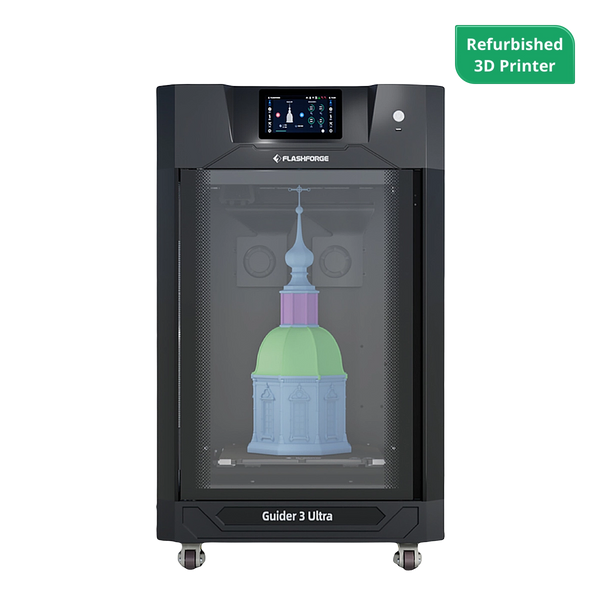
A large format 3D printer goes beyond that standard desktop range. It may offer a wider build plate, more vertical height, or both. For example, the Flashforge Guider 3 Ultra is listed with a 330 × 330 × 600 mm large build volume, which makes it especially useful for tall models and larger prototypes.
Large Format 3D Printer vs Desktop 3D Printer
A desktop 3D printer is usually easier to place, easier to manage, and more affordable. It is a better fit for small prototypes, classroom projects, hobby prints, replacement parts, and simple functional parts.
A large-format 3D printer is designed for users who need more printable space. It is better for large prototypes, cosplay props, architectural models, fixtures, tall parts, and batch printing. The tradeoff is that large format printing requires stronger frame stability, better bed leveling, longer print reliability, and more attention to print monitoring.
When Bigger Build Volume Actually Matters
Bigger build volume matters when the part size directly affects the final result. If splitting a model creates weak seams, visible glue lines, extra sanding, or alignment problems, printing in one piece can save time and improve quality.
Large build volume also matters when parts are tall. A printer with more Z height can produce vertical prototypes, vases, fixtures, tubes, housings, and display models without dividing them into sections.
Types of Large Format 3D Printers
Large format 3D printers are not all built for the same job. Before comparing prices or specs, you need to understand which printing process fits your material, detail, strength, and production needs.

Large Format FDM 3D Printers
Large format FDM 3D printers use thermoplastic filament and build parts layer by layer. They are common for prototypes, props, fixtures, tooling, educational models, and functional parts.
Before choosing a large machine, make sure your preferred 3d printer filament matches the printer’s nozzle temperature, bed temperature, extrusion system, and support material workflow. Flashforge’s filament collection includes common materials such as PLA, HS PLA, PETG, and other options for different printing needs.
FDM is often the most practical large format choice because filament is easier to store, material costs are usually manageable, and post-processing can be simple. If you are still comparing materials, Flashforge’s guide to 3D printer filament types is a useful internal reference for understanding PLA, PETG, ABS, TPU, ASA, nylon, PC, and other common options.
Large Format Resin 3D Printers
Large format resin 3D printers use liquid photopolymer resin and light curing. They are often chosen when fine surface detail is more important than filament-based workflow simplicity.
Resin can produce smoother details, but large resin printing also brings handling, washing, curing, odor, and safety requirements. NIOSH notes that safe 3D printing practices are important for makerspaces, schools, libraries, and small businesses, especially when handling materials and emissions in shared spaces.
Powder-Based Large Format 3D Printers
Powder-based 3D printers use powdered materials and binders, lasers, or other energy sources to create parts. These systems are more common in industrial, engineering, and production environments than in normal desktop workflows.
They can be useful for complex shapes, production parts, or specific material requirements, but they usually require more space, more safety controls, and more post-processing than FDM printers.
Pellet and Robotic Arm Large Format Printers
Pellet and robotic arm large format printers are used for very large parts, molds, furniture-scale objects, tooling, and industrial applications. Instead of standard filament spools, pellet printers can process plastic pellets at higher output rates.
These systems are powerful but not ideal for most small studios or home users. They require more setup, material planning, safety controls, operator training, and floor space.
How to Choose a Large Format FDM 3D Printer
For most buyers, a large format FDM 3D printer is the most practical starting point. The right machine should match your part size, material needs, support requirements, print duration, and workspace.
Build Volume and Printable Part Shape
Do not choose a large printer only by the biggest number on the spec sheet. Look at the actual shape of your parts. Some users need more width. Others need more height. Some need both.
The Flashforge Guider 3 Ultra is especially relevant for tall parts because its 330 × 330 × 600 mm build volume provides much more vertical room than standard desktop printers.

Frame Stability and Motion Structure
Large prints take longer, so the printer must stay stable for many hours. Frame rigidity, motion structure, belt tension, vibration control, and bed leveling all affect the final result.
A large build volume is only useful if the printer can maintain accuracy across the full space. Flashforge lists the Guider 3 Ultra with a CoreXY structure, which is designed to support rigidity, precision, and stable printing. (Flashforge)
Extruder System and Support Materials
Large and complex parts often need support material. For simple shapes, normal supports may be enough. For deep overhangs, hollow structures, internal channels, and fragile details, soluble support can make removal much easier.
The Guider 3 Ultra uses a dual extruder system that supports soluble support workflows for complex models with overhangs, bridges, and hollow structures. This makes it more useful for prototypes and fixtures where manual support removal would be difficult.
Material Compatibility and Print Conditions
Material choice affects printer requirements. PLA is easier for visual models. PETG can be useful for tougher parts. ABS, ASA, nylon, PC, and carbon fiber filled materials may need higher temperatures, controlled airflow, or an enclosed print environment.
Before choosing a large format FDM 3D printer, confirm nozzle temperature, bed temperature, enclosure design, support material compatibility, and slicer profiles. Material support matters as much as build volume when the part needs strength, heat resistance, or long-term durability.
Long Print Reliability and Monitoring
Large prints can run for many hours or even days. That means reliability matters more than it does for small prints. Look for automatic bed leveling, filament runout detection, stable extrusion, remote monitoring, and recovery features.
Flashforge’s guide to best high speed 3D printers explains why speed should not be judged by maximum movement alone. Build volume, support strategy, material feeding, and print stability all affect the final workflow, especially for larger models.
Recommended Pick: Flashforge Guider 3 Ultra
Flashforge Guider 3 Ultra is a suitable choice for users who need a true large format FDM 3D printer for tall models, large prototypes, props, fixtures, and complex functional parts. Its 330 × 330 × 600 mm build volume gives users more vertical space than standard desktop printers, while the dual extruder system supports soluble support workflows for complex structures.
It is also designed for demanding workflows. Flashforge lists the Guider 3 Ultra with 500 mm/s printing speed, 20,000 mm/s² acceleration, a CoreXY structure, automatic bed leveling and calibration, and dual extruders that simplify complex models with soluble supports. (Flashforge)
When You Need a Large Format 3D Printer
A large format 3D printer makes sense when size creates a real production advantage. If your current printer can already make your parts cleanly and efficiently, a larger machine may not be necessary.
Your Parts Exceed Standard Desktop Build Volume
The most obvious reason to buy a large format 3D printer is that your parts do not fit inside a standard desktop printer. If you constantly resize, split, or redesign models just to fit the build plate, a larger machine can simplify your workflow.
This applies to props, architectural models, large enclosures, tall prototypes, fixtures, product samples, and display models.
Splitting Models Creates Weak Assembly Points
Splitting a model can create weak joints, visible seams, alignment issues, and extra finishing work. For decorative models, this may only affect appearance. For functional parts, it can affect strength.
A large format printer helps when the final part needs cleaner surfaces, fewer glue joints, or better structural continuity.
Tall Prototypes Need More Vertical Space
Some parts do not need a very wide build plate but still need more height. Tall prototypes, tubes, columns, vertical housings, vases, display models, and fixtures can benefit from a printer with more Z height.
This is one reason the Guider 3 Ultra’s 600 mm Z height matters. It gives users more room for tall models that would be difficult to print on a smaller desktop machine.
Complex Parts Need Soluble Supports
Complex prototypes often include overhangs, hollow areas, bridges, internal geometry, or support areas that are hard to reach by hand. If support removal can damage the part, a dual extruder workflow becomes more valuable.
This is where Guider 3 Ultra becomes more relevant. Its dual extruder system can support soluble support workflows, making it a stronger fit for complex prototypes, fixtures, and models where manual support removal would be difficult or risky.
Batch Printing Needs More Building Area
Large format does not only mean large single parts. A bigger build area can also help with batch printing. You can place multiple smaller parts on the same build plate and reduce the number of print cycles.
This can be useful for small production runs, educational labs, print services, and teams making repeated fixtures or sample parts.
When You May Not Need a Large Format 3D Printer
A large format 3D printer is not always the best purchase. If your work is mostly small, material-specific, or budget-limited, another type of machine may be a better fit.
Standard Desktop Size May Be Enough
If most of your prints are small tools, prototypes, organizers, toys, tabletop models, or classroom prints, a standard desktop 3D printer may be enough. In that case, it may be better to compare the best 3d printer options by build volume, enclosure design, material support, and daily workflow before moving up to a large format machine.
Buying a large format printer only for occasional oversized projects can lead to unused capacity, higher material planning, and unnecessary workspace demands.
Engineering Materials May Matter More Than Size
Some users do not need more build volume. They need better material support. If your main goal is printing ABS, ASA, PC, PA, or fiber-reinforced filaments, an enclosed printer with stable chamber conditions may matter more than maximum build size.
In that case, compare nozzle temperature, heated bed performance, enclosure design, filtration, and chamber control before choosing the largest machine.
Workspace and Budget Limits
Large printers need more physical space. You need room for the printer body, door opening, filament loading, ventilation, maintenance access, and safe operation.
Budget should also include filament, spare nozzles, build surfaces, support materials, electricity, storage, and possible ventilation improvements. A large printer with poor workspace planning can become harder to use than a smaller printer that fits your workflow.
Large Format FDM 3D Printer Buying Checklist
A checklist helps you avoid buying based only on build volume. The best large format FDM 3D printer should fit your real part size, material plan, workspace, and monitoring workflow.
Measure Your Real Part Size First
Before comparing machines, measure the parts you actually want to print. Check the longest width, deepest depth, and tallest height. Then add some margin for brims, supports, skirts, and placement flexibility.
If your parts are tall but not wide, prioritize Z height. If your parts are wide and flat, prioritize bed area. If your parts are both tall and wide, confirm that the printer can maintain quality across the full volume.
Check Printer Footprint and Clearance
The build volume is not the same as the printer footprint. A large format 3D printer needs extra room around it for loading filament, opening doors, removing parts, cleaning the bed, and maintaining the extruder system.
Also check table strength, floor stability, ventilation, cable routing, and whether the printer can physically fit through doors or into your workspace.
Plan Filament Use and Print Time
Large prints use more filament and take longer. A failed print near the end of a long job wastes more time and material than a failed small print.
Estimate filament use before printing. Check spool capacity, support material use, infill settings, wall count, and whether the model can be lightened without reducing needed strength.
Match Software and Monitoring Workflow
Large format printing benefits from reliable software, remote monitoring, and clear slicer settings. Confirm that your slicer supports the printer, extruders, materials, and support workflows you need.
For long jobs, monitoring is not optional. A camera, remote status check, filament detection, and pause or recovery features can reduce the risk of losing a large print.
Conclusion
A large format 3D printer is worth buying when your parts are too large for a standard desktop machine, splitting models creates weak seams, tall prototypes need more vertical room, or complex parts need soluble supports. The right machine should be chosen based on real part size, print stability, material compatibility, support strategy, and long print reliability.
For users who need a large format FDM 3D printer for tall models, props, fixtures, large prototypes, and complex parts, the Flashforge Guider 3 Ultra is a strong option. Its 330 × 330 × 600 mm build volume, CoreXY structure, dual extruders, soluble support workflow, automatic leveling, and production-focused design make it suitable for serious large format printing.
FAQ
How much does a giant 3D printer cost?
A giant 3D printer can cost anywhere from a few thousand dollars for professional large format FDM printers to much higher prices for industrial resin, powder, pellet, or robotic arm systems. The exact cost depends on build volume, materials, extruder system, enclosure, support workflow, and industrial requirements.
For a real Flashforge example, check the live product page for the Flashforge Guider 3 Ultra, and review the current 3d printer for sale page because pricing, promotions, shipping terms, and regional availability can change. Flashforge’s sale page is positioned around current 3D printer deals and savings.
Are large 3D printers worth it?
Large 3D printers are worth it when you regularly print parts that exceed standard desktop build volume, need fewer seams, require more vertical space, or benefit from batch printing. They are also useful for props, fixtures, large prototypes, and complex models.
They may not be worth it if most of your parts are small, your workspace is limited, or your main need is engineering material support rather than size.
What is the lifespan of a 3D printer?
The lifespan of a 3D printer depends on machine quality, maintenance, workload, materials, and operating environment. A well-maintained printer can run for years, but wear parts such as nozzles, build surfaces, belts, fans, and extruder components may need replacement over time.
For large format printers, maintenance matters even more because long prints place more demand on motion systems, extrusion consistency, cooling, and bed adhesion.
How much does it cost to run a 3D printer for 1 hour?
The electricity cost depends on printer power draw and your local electricity rate. A simple formula is:
Hourly cost = printer power in kW × electricity price per kWh
For example, if a printer averages 0.3 kW during a job and electricity costs $0.14 per kWh, the electricity cost is about $0.042 per hour. The U.S. Energy Information Administration reported an average U.S. electricity price of 13.88 cents per kWh in April 2026, but your local rate may be higher or lower.
For large format printing, filament, support material, failed print risk, maintenance, and labor usually matter more than electricity alone.