


CoreXY and bed slinger printers can both produce accurate, reliable parts. The main difference lies in how they move.
A CoreXY printer uses a coordinated belt system to move the toolhead across the X and Y axes. Its build plate usually stays fixed across the horizontal plane and moves only along the Z-axis. A bed slinger uses a simpler layout. Its print bed moves back and forth along the Y-axis while the toolhead handles the remaining motion.
This structural difference affects speed, stability, workspace requirements, maintenance, and cost. However, neither system is automatically better for every project. A well-tuned bed slinger can produce clean, detailed prints. A carefully designed CoreXY printer provides more room for higher acceleration, frequent production, and tall models.
This guide explains how each motion system works and helps you decide which structure fits your printing needs.
What Is a CoreXY 3D Printer?
A CoreXY printer uses two frame-mounted motors and a coordinated belt system to move the toolhead across the horizontal plane.
CoreXY still operates within an X, Y, and Z coordinate system. The name describes the mechanical layout used to control horizontal movement, not a separate coordinate system.
For a broader technical comparison, read the Flashforge guide to CoreXY and Cartesian 3D printers.
Coordinated Belt-Driven XY Motion System
In a CoreXY system, two motors work together to control the movement of the toolhead.
The motors remain attached to the frame. The toolhead moves across the X and Y axes without carrying the weight of the motors. This reduces moving mass and makes rapid changes in direction easier to manage.
The structure supports higher acceleration when the frame, belts, and pulleys are designed correctly. It can also reduce the vibration created by heavy moving components.
CoreXY still requires careful engineering. Belt tension, pulley alignment, frame rigidity, calibration, and vibration control all affect the final result.

Stationary Bed Design with Z-Axis Movement
The CoreXY build plate is stationary across the horizontal plane. It usually moves vertically along the Z-axis as each new layer is added.
This means the printed object is not carried back and forth during rapid XY movement. The toolhead performs the faster motion while the bed rises or lowers in smaller steps.
This structure can improve stability during tall prints and high-speed jobs. However, performance still depends on the Z-axis design, frame rigidity, slicer settings, and material.
A CoreXY label alone does not guarantee better print quality. The complete machine design matters.
What Is a Bed Slinger (Cartesian i3 Style)?
A bed slinger is a moving-bed printer design often associated with Cartesian i3-style machines.
The terminology needs one clarification. CoreXY also operates within Cartesian coordinates. Not every Cartesian printer is a bed slinger. In this article, bed slinger refers specifically to printers with a build plate that moves along the Y-axis.
Y-Axis Moving Print Bed Structure
In a typical bed slinger, the print bed moves forward and backward along the Y-axis.
The toolhead usually moves along the X-axis, while the Z-axis controls the vertical distance between the nozzle and the bed. The printed object travels with the platform throughout the job.
This design is easy to understand because each axis has a visible role. It also makes troubleshooting more straightforward.
The trade-off becomes more noticeable as a model grows taller or heavier. The printer must move the combined weight of the bed, build plate, and printed object during every Y-axis change of direction.
Simple and Affordable Cartesian Motion Design
Bed slingers remain popular because their mechanical structure is relatively simple.
Belts, rails, rollers, and wiring are usually easy to inspect. Routine maintenance is often straightforward because the movement path is visible and accessible.
The simpler structure can also reduce manufacturing cost. This makes bed slingers practical for beginners, schools, and hobbyists who print occasionally.
A lower price does not mean poor print quality. A calibrated bed slinger can produce detailed models and useful parts. It may simply need more conservative acceleration settings for large or tall prints.
CoreXY vs Bed Slinger: Key Differences
The motion system affects more than speed. It also changes how the printer handles vibration, how much desk space it needs, and how easy it is to maintain.
Understanding these differences makes it easier to choose a printer that fits your actual workload.
Print Speed and Acceleration Performance
CoreXY printers usually have a higher performance ceiling.
Because the motors remain fixed to the frame and the bed does not move rapidly along the Y-axis, the printer can reduce moving mass during frequent direction changes. This makes higher acceleration easier to control.
A bed slinger can also print quickly. However, its bed, build plate, and growing model move together. As the moving mass increases, aggressive acceleration can create more vibration, ringing, or layer-shift risk.
The motion system is only one factor. Hotend flow, cooling, frame rigidity, slicer settings, vibration compensation, and material also affect usable print speed.
When comparing a high speed 3d printer, review acceleration, extrusion flow, cooling, and real print quality alongside the headline speed. A printer needs to maintain stable output on actual projects, not only reach a high maximum figure under selected conditions.

Stability When Printing Tall Objects
Tall prints place greater demands on the motion system, and this is one area where CoreXY generally has a stability advantage over a bed slinger. Because the printed object remains stationary across the horizontal plane instead of moving back and forth with the bed, tall models are often less affected by inertia and vibration during rapid direction changes.
On a bed slinger, the growing object moves along the Y-axis with the build plate. A narrow tower, tall enclosure, or large figurine may sway more as its height increases. Lowering the acceleration can help maintain stability.
A CoreXY printer keeps the model stable across the horizontal plane. This can make tall prints easier to manage at higher speeds.
The advantage is not absolute. A CoreXY machine still needs a rigid frame, a stable Z-axis, balanced belts, and suitable print settings. A carefully tuned bed slinger can also produce clean tall parts.
Machine Size and Workspace Requirements
A bed slinger requires additional front-to-back operating space because the build plate travels along the Y-axis during printing.
A machine may look compact when measured at rest, but the bed still needs room to travel along the Y-axis. This matters in a home office, classroom, or small workshop.
A CoreXY printer usually keeps its main movement inside a box-like frame. This can make desk placement easier for a similar build area.
Accessories still affect the final footprint. Spool holders, filament tubes, enclosures, and dry boxes can increase the space required. Always check the complete setup before choosing a location.
Maintenance and Mechanical Complexity
Bed slingers are often easier to inspect and maintain.
Their movement paths are simple. A beginner can usually see how each belt and rail affects the related axis.
CoreXY printers use a more coordinated belt arrangement. Belt tension and alignment require closer attention because both motors contribute to horizontal movement.
Modern CoreXY printers reduce much of this workload through factory assembly, automatic leveling, and simplified calibration. Daily use can remain straightforward even when the underlying mechanism is more advanced.
Cost and Entry-Level Accessibility
Bed slingers have traditionally been one of the most accessible starting points for 3D printing.
Their simple design can reduce cost and make repairs easier to understand. They remain practical for basic learning, occasional projects, and budget-focused setups.
CoreXY printers now cover a wider range of price points. Some models are designed for beginners, while others target studios and production teams.
When browsing a 3d printer for sale, compare more than the initial price. Build volume, automation, nozzle options, material support, enclosure design, and maintenance requirements all affect long-term value.
Real-World Example: Flashforge Creator 5 Pro as a CoreXY Toolchanger
The Flashforge Creator 5 Pro shows how a CoreXY platform can support professional desktop workflows.
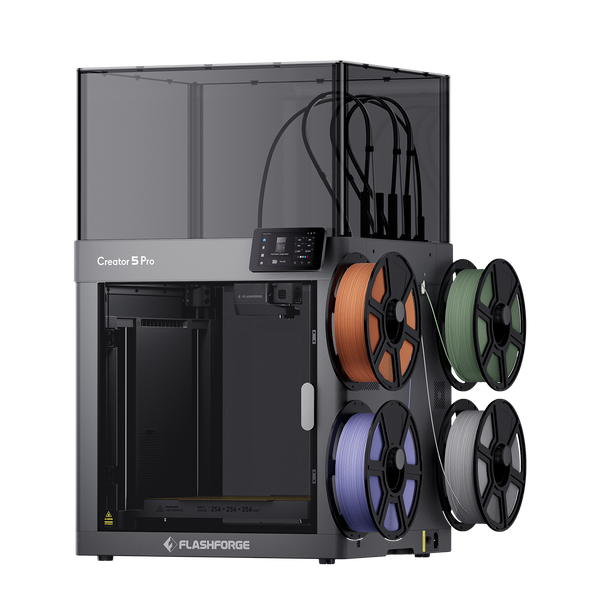
Flashforge Creator 5 Pro 4-Toolheads Enclosed Multi-Color 3D Printer | 500% Faster, Zero Purge Waste
Its CoreXY motion system handles rapid XY movement while the build plate moves vertically along the Z-axis. The printer reaches a maximum print speed of 300 mm/s, a maximum travel speed of 600 mm/s, and acceleration up to 30,000 mm/s².
The rigid enclosed frame and actively heated chamber up to 65°C create a more controlled environment for engineering materials. This is useful for prototypes and selected small-batch parts that need improved dimensional consistency.
Creator 5 Pro also includes four independent toolheads managed by the FlashSwap tool-changing system. This is a separate feature from the CoreXY motion structure.
CoreXY controls how the printer moves. FlashSwap expands the workflow by supporting multi-color and multi-material printing with zero purge waste during material switching.
Not every CoreXY printer is a toolchanger. The two features should be evaluated separately.
Which Motion System Is Better for Your Use Case?
The right choice depends on what you print, how often you use the machine, and how much maintenance you want to manage.
The best 3d printer is not defined by its motion system alone. It should match your materials, build-volume needs, speed requirements, workspace, and budget.
The Flashforge guide to choosing the best FDM 3D printer recommends comparing speed, materials, build volume, automation, and budget together rather than focusing on one specification.
Best Choice for Beginners and Budget Users
A bed slinger remains a practical starting point for beginners.
Its structure is simple, familiar, and easy to inspect. If you mainly print small PLA models, classroom aids, or basic household items, the speed advantage of a CoreXY machine may not be essential.
CoreXY printers are also becoming more accessible. Factory-assembled models can offer automatic leveling and a simpler setup process without requiring extensive mechanical adjustments.
Start with your project list. Choose the printer that makes those projects easier to complete rather than paying for features you may not use.
Best Choice for High-Speed and Production Printing
When printing speed, output volume, and workflow efficiency become priorities, CoreXY is usually the stronger option.
A production printer needs more than a fast motion system. Look for a rigid frame, reliable calibration, stable extrusion, suitable cooling, and an enclosure that matches the materials you plan to print.
Material selection also affects throughput and print quality. The right 3d printer filament should match the nozzle temperature, enclosure design, and performance requirements of the finished part.
The Flashforge Creator 5 Pro is designed for this type of workflow. Its CoreXY structure supports rapid movement, while its enclosed frame and active chamber heating improve environmental control. The four independent FlashSwap toolheads also reduce the time and waste associated with repeated material changes.
Flashforge Creator 5 Pro 4-Toolheads Enclosed Multi-Color 3D Printer | 500% Faster, Zero Purge Waste
These features make it relevant for design studios, engineering teams, and small-batch production workflows.
Maximum speed should not be the only buying factor. Stable repeatability matters more than a headline figure when a printer is used for production.
Best Choice for Large or Tall Functional Parts
CoreXY is often well suited to large or tall models.
The build plate remains stable across the horizontal plane, so the object does not move back and forth during rapid XY travel. This can help when printing tall enclosures, fixtures, prototypes, and display models.
However, the motion system is only one part of the setup. Build volume, Z-axis stability, wall thickness, print orientation, and support strategy still matter.
A bed slinger can also print tall models when the acceleration is adjusted carefully. The right choice depends on the part size and the expected production pace.
Best Choice for Low-Maintenance Everyday Printing
A bed slinger can still be the better option for occasional use.
Its simple structure makes it easy to understand and inspect. This is useful when you print a limited number of PLA models and do not need aggressive acceleration.
A factory-assembled CoreXY machine can also work well for everyday printing when automatic leveling and simplified maintenance are priorities.
Choose the structure that matches your workload. A printer should make your projects easier, not add maintenance tasks you do not need.
Pros and Cons Summary
The following table summarizes the main trade-offs.
|
Factor |
CoreXY |
Bed Slinger |
|
XY motion |
Toolhead moves through coordinated belt control |
Bed moves along the Y-axis |
|
Speed potential |
Better suited to higher acceleration and frequent direction changes |
Can print quickly but may need more conservative settings |
|
Tall-print stability |
Model remains stable across the horizontal plane |
Tall models move with the bed |
|
Workspace |
Main motion usually stays within the frame |
Needs front and rear clearance for bed travel |
|
Maintenance |
More complex belt routing and tensioning |
Simpler structure and easier inspection |
|
Entry-level accessibility |
Available across beginner and professional ranges |
Often affordable and easy to understand |
|
Best fit |
High-speed printing, frequent production, and tall models |
Beginners, occasional printing, and low-maintenance setups |
CoreXY Advantages and Trade-Offs
CoreXY printers provide a strong foundation for faster movement and improved stability during tall prints.
The lower moving mass also makes the structure suitable for frequent printing and production workflows.
The trade-off is mechanical complexity. Belt routing, tension, frame rigidity, and calibration all need careful attention. A weak CoreXY design does not become reliable simply because it uses the right label.
Bed Slinger Advantages and Trade-Offs
Bed slingers remain practical because they are simple, accessible, and easy to maintain.
They can produce high-quality parts at appropriate speeds and work well for common hobby projects.
The main limitation is the moving bed. As the printed object becomes taller or heavier, acceleration may need to be reduced to maintain stability.
Conclusion
CoreXY and bed slinger printers can both produce reliable results. CoreXY is generally better for high-speed printing, frequent use, and tall models because the build plate remains stable while the toolhead handles rapid movement.
A bed slinger is often a good choice for beginners and budget-conscious users due to its simpler design and easier maintenance. The best option depends on your printing needs, budget, available space, and desired features.
FAQ
Is CoreXY Always Faster Than a Bed Slinger?
No.
CoreXY has a mechanical advantage for higher acceleration because the bed does not move rapidly along the Y-axis. This can improve usable speed during frequent printing and larger projects.
Actual performance still depends on the frame, belts, cooling, nozzle flow, firmware, slicer settings, and material.
A well-tuned bed slinger can still print quickly and produce clean parts.
Can Bed Slingers Produce High-Quality Prints?
Yes.
A calibrated bed slinger can produce accurate and detailed models. Print quality depends on more than the motion system.
Bed leveling, nozzle condition, material, cooling, print orientation, and acceleration all matter.
For tall or heavy prints, more conservative acceleration settings can help improve stability.
Is CoreXY Harder to Maintain?
It can be.
CoreXY belt routing is more complex than the direct Y-axis bed motion used by a typical bed slinger. Belt tension and alignment need to remain balanced.
However, modern factory-assembled CoreXY printers often include automatic leveling and simplified calibration.
The underlying mechanism may be more advanced, but routine maintenance can still remain manageable.
Which System Is Better for Beginners?
Both systems can work for beginners.
A bed slinger is easy to understand and often affordable. It remains a practical option for basic learning and occasional printing.
An entry-level CoreXY printer may be a better fit when faster everyday printing, automatic setup, and a more stable platform are priorities.
Start with your budget, materials, and project types. Choose the structure that makes those projects easier to complete.