


The global 3D printing market continued to grow in 2025, with global additive manufacturing revenues reaching $24.2 billion, up 10.9% year over year. Growth is increasingly supported by printing services, systems, materials, software, and wider production adoption.
In this article, we will analyze the cutting-edge trends in 3D printing innovation, including AI-driven generative design, bioprinted organs, and the global standardization of sustainable materials, providing some insights into the future landscape of 3D printing technology for in-depth 3D printing enthusiasts and investment experts in the 3D printer industry.
The New Wave of 3D Printer Innovation and 3D Printing Trends
The 3D printing industry is at an important stage in its technological development. Traditional additive manufacturing still faces limitations such as slower production speeds, limited material options, and complex post-processing requirements. Recent technological advances are helping address many of these challenges. These innovations not only improve performance but also lower adoption barriers, making additive manufacturing more accessible to small and mid-sized businesses.
AI-Driven Design for A Top 3D Printing Trend
Artificial intelligence is changing how 3D-printed parts are designed and optimized. Generative design can explore multiple design options under engineering constraints, helping reduce design time and improve part efficiency.
In suitable applications, generative design can also reduce part weight. For example, one Autodesk case study achieved a 40% weight reduction on an electric hypercar component. Flashforge slicing software, Flash Studio Desktop, formerly known as Orca-Flashforge, reflects this shift toward more connected slicing workflows.
Machine learning is also being used for defect detection and process optimization. By analyzing print data and sensor information, AI systems can help identify problems, adjust parameters, and improve print consistency.

Software innovation is also changing how users prepare and manage print jobs. FlashPrint remains Flashforge’s self-developed slicer for users who prefer a straightforward model-preparation workflow, while Flash Studio Desktop is the current name of the software formerly known as Orca-Flashforge for supported printers. Users looking for a FlashPrint download should use the official Flashforge Download Center and select the installer that matches their operating system and printer model.
High-Speed Production for An Innovative 3D Printing Shift
Speed has long been a major limitation in scaling 3D printing. Continuous Liquid Interface Production (CLIP), pioneered by Carbon, enables continuous resin printing by controlling the interaction between light and oxygen. By avoiding the repeated peeling steps used in traditional resin printing, CLIP can significantly reduce print time and improve production speed.
In FDM 3D printing, high-speed desktop systems can now reach speeds of up to 600 mm/s and acceleration of 20,000 mm/s². These improvements make faster prototyping and selected small- to medium-batch workflows more practical.

Advanced & Multi-Material 3D Printer Innovation
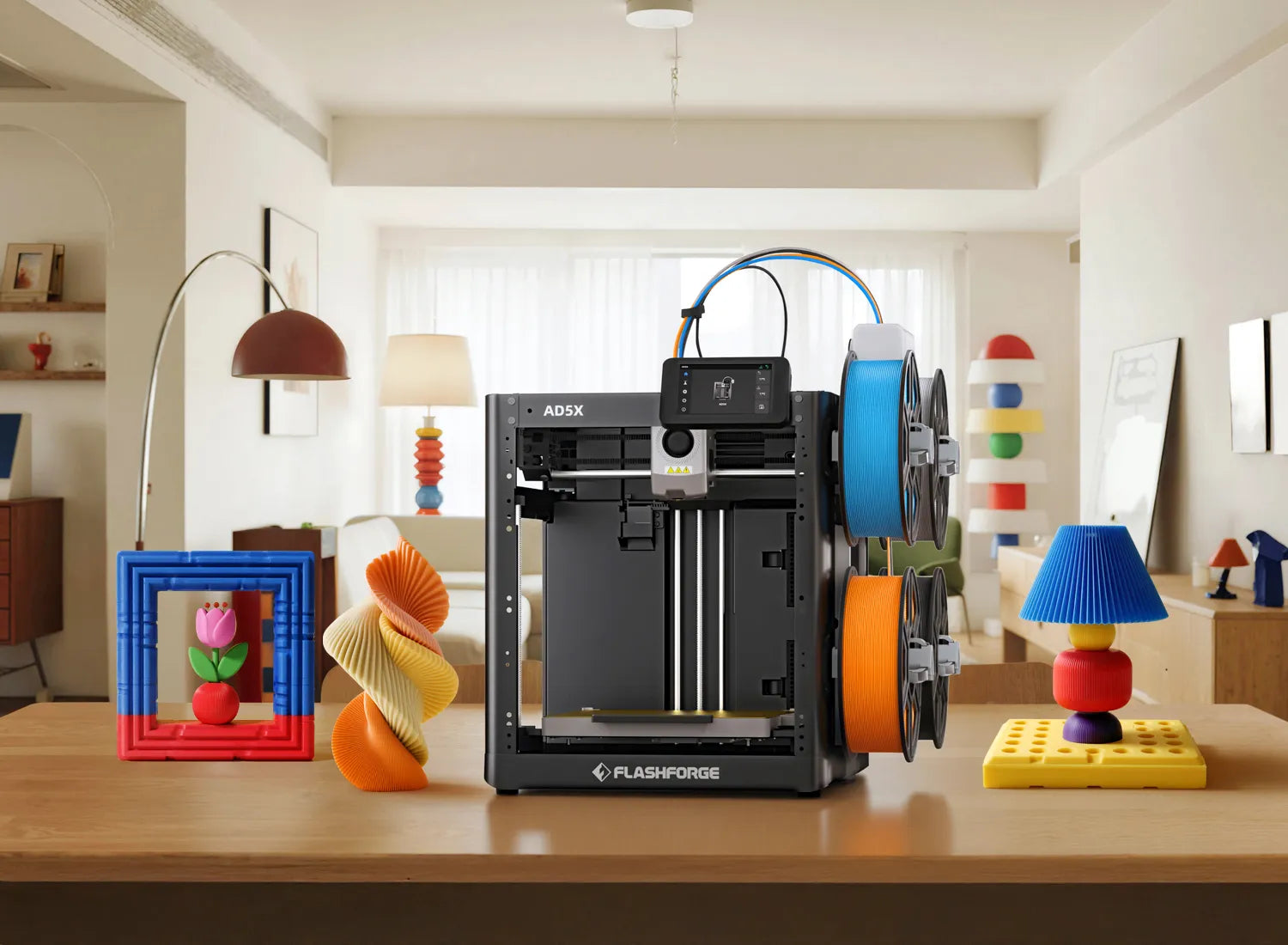
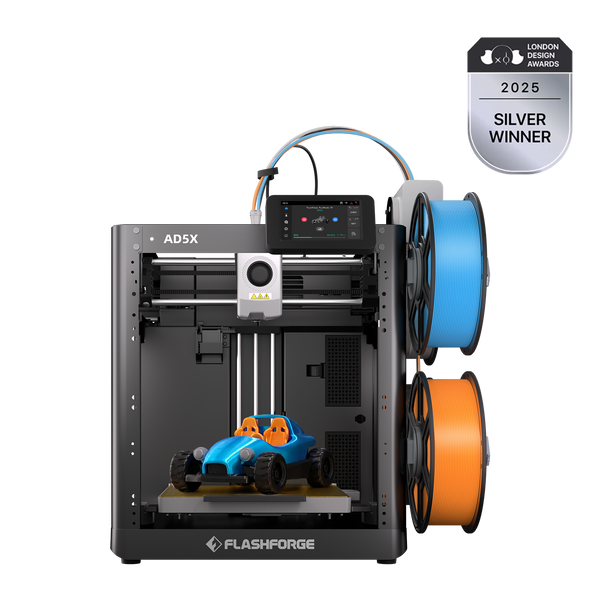
Multi-material 3D printing expands the range of colors and material properties that can be used in a single workflow. In FDM 3D printing, multi-nozzle and filament-switching systems support different approaches to multicolor and multi-material printing. Flashforge's multi-filament AD5X 3D printer focuses on accessible four-color printing and also supports multicolor TPU 64D applications.
Full-color 3D printing has also advanced through material-jetting systems that use CMYK-based workflows to create detailed gradients and blended colors. This approach differs from filament-based multicolor FDM printing, where separate filaments or toolheads are typically used for color changes.
However, color-mixing 3D printing still faces challenges - experiments in FDM attempting to create any color by blending cyan, magenta, yellow and white filaments have shown that due to the non-laminar flow characteristics of the melt, the actual results are often unsatisfactory. This is also one of the key areas for future 3D printing industry researchers to break through.

Large-Format Printing for A Massive 3D Printing Trend
Large-format 3D printing is transforming the production methods in industries such as construction, aerospace, and shipbuilding. In the field of architecture, Apis Cor collaborated with the Dubai municipal government to build the world's largest 3D-printed structure at that time - a two-story office building 9.5 meters high. Chinese company Winsun has utilized 3D printing technology to mass-produce prefabricated house components, demonstrating the potential of this technology in addressing the global housing crisis. Companies like ICON are commercializing 3D-printed buildings, enabling rapid and economical residential construction through proprietary robotic systems, software and advanced materials. The aerospace field also benefits from large-format printing.
Lockheed Martin has used Sciaky's electron beam additive manufacturing (EBAM) technology to manufacture titanium alloy satellite fuel tank domes that are up to 6 meters high and 1.2 meters wide, significantly reducing the production cycle. Boeing's 777x engine contains over 300 3D-printed components, which have reduced weight and costs through component integration. Large-format FDM 3D printer systems are used for producing large components, including applications in the aerospace industry. The challenges of large-format printing include material consistency, thermal management and quality control, but with technological advancements, these issues are gradually being addressed.

Automatic Hot End Change System
Automatic hotend changing improves multicolor and multi-material printing by allowing a printer to switch between dedicated hotends during a job. Each hotend can be assigned to a different filament or color, reducing the need for repeated material changes through a single nozzle.
Bambu Lab's VORTEK system supports up to six interchangeable hotends. Combined with an additional fixed hotend, it can handle up to seven colors or materials in one print while reducing purge during tool changes.
The system uses contactless communication to identify hotends and synchronize operating information with the printer, helping manage temperature and tool changes more reliably. This approach can reduce material waste and make complex multicolor or multi-material workflows more efficient.

Hybrid & 5-Axis 3D Printer Innovation
Hybrid manufacturing combines additive and subtractive processes within one workflow, allowing parts to move from near-net-shape production to precision finishing. Multi-axis printing adds more flexibility by changing the build direction and printhead orientation, enabling deposition along curved surfaces and reducing some of the limitations of traditional layer-by-layer printing.
Software such as Siemens NX AM Multi-Axis supports complex toolpath planning for robotic and machine-tool systems. These technologies are increasingly used for prototyping, small-batch production, component repair, and coating, where additive manufacturing can create or restore the basic geometry before machining brings the part to its final dimensions and surface finish.

Bioprinting as an Emerging 3D Printing Frontier
Bioprinting is one of the most ambitious applications of 3D printing, with researchers developing increasingly complex tissues and vascularized structures. Using patient-derived cells could eventually support regenerative medicine and help address organ shortages, although major technical and clinical challenges remain.
The process generally includes three stages. Digital models are first created from medical imaging, and bio-inks containing cells and biomaterials are prepared. The bio-ink is then deposited using extrusion, inkjet, or laser-assisted methods before the printed tissue is cultured to support maturation.
Recent research is improving vascular network design, print consistency, and bio-ink materials. Stanford researchers, for example, have developed tools for designing complex vascular structures, while other teams are working on process control and hydrogels that could support more functional printed tissues.
Automation & Post-Processing as a Core 3D Printing Trend
Post-processing remains a time-consuming part of many 3D printing workflows, making automation increasingly important. Machine learning and computer vision can support defect detection, quality monitoring, and parameter selection, while automated finishing systems can adjust polishing, blasting, or other processes based on sensor feedback.
Robotic post-processing is also becoming more common in metal additive manufacturing. In 2026, key priorities include greater automation, consistent quality control, resource efficiency, and better process traceability.

Sustainability for An Eco-Friendly 3D Printer Innovation
Additive manufacturing can reduce material waste compared with subtractive processes, especially for complex geometries and lower production volumes. However, its overall environmental impact still depends on the process, material, energy use, post-processing, and production scale.
Bio-based materials can offer alternatives to conventional polymers. PLA 3D printing filament is commonly made from plant-derived feedstocks such as corn or sugarcane and can break down under suitable industrial composting conditions. Other bio-based and fiber-filled materials are also being developed to reduce reliance on conventional plastics.
Sustainability also extends beyond materials. On-demand production can reduce excess inventory and waste, while localized manufacturing may reduce transportation requirements in some supply chains. Faster prototyping can also help identify design problems before larger production runs.
Standardization for The 3D Printing Trend for Mass Adoption
Standardization is important as 3D printing moves from prototyping toward broader production use. ISO and ASTM International have developed a framework covering general requirements, materials and processes, and application-specific standards across industries such as aerospace, medical, and automotive manufacturing.
The adoption of 3MF as ISO/IEC 25422:2025 is another step toward more standardized data exchange. Compared with STL, 3MF can store richer model and manufacturing information, supporting more complete digital workflows for additive manufacturing.

A quality certification system is being established. The AMQ certification program of ASTM Additive Manufacturing Center of Excellence (AM CoE) is based on international standards such as ISO/ASTM 52901:2017 and ISO/ASTM 52904:2019, providing a modular and comprehensive certification approach for additive manufacturing facilities. The DNV-ST-B203 standard of DNV is the first standard to provide an internationally recognized framework for high-quality metal additive manufacturing components in the oil and gas, maritime and related industries.
Standardization is also being advanced in the field of architecture. ISO/ASTM 52939:2023 stipulates the quality assurance requirements for construction projects using additive manufacturing technology, which are independent of the materials and process categories used. NASA and other institutions have issued minimum requirements standards for additive manufacturing components for manned spaceflight applications.
Although 3D printing still faces challenges in speed, repeatability, and quality control, high-speed printing, automation, AI integration, and hybrid manufacturing are expanding production applications. Large print farms such as Slant 3D show that FDM can compete with injection molding for some production runs, although the break-even point depends on part geometry, tooling costs, material, and order volume. The aerospace, automotive, medical and consumer goods industries are leading the application of scalable 3D printing.
Conclusion for The Future of 3D Printing Trends and Innovative 3D Printing
3D printing technology is standing at the critical point of large-scale industrial application. The ten innovative advancements in 3D printing technology discussed in this article collectively form a complete picture of the transformation of additive manufacturing from prototype tools to mainstream production technologies. The pace of technological progress is encouraging, and many goals that once seemed out of reach are now becoming a reality. It is expected that in the next 3 to 5 years, we will witness breakthroughs in 3D printing in more fields.
FAQ About 3D Printing Trends
What Is the Biggest 3D Printing Trend in 2026?
AI-assisted design and automated production are among the most important 3D printing trends in 2026. Generative design, defect detection, connected slicing software, and real-time process monitoring are helping users reduce setup work and improve printing consistency.
How Is AI Used in 3D Printing?
AI is used to generate models, optimize part structures, recommend printing parameters, detect defects, and monitor print quality. Its value extends beyond model creation because machine-learning systems can also analyze previous print data and identify settings that may improve accuracy or reduce failures.
Is High-Speed 3D Printing Suitable for Production?
High-speed 3D printing can support prototyping and selected small- or medium-batch production, but maximum speed alone does not guarantee faster output. Acceleration, material flow, cooling, model geometry, and slicer settings all affect the actual print time and finished-part quality.
What Is the Difference Between Multi-Color and Multi-Material 3D Printing?
Multi-color printing uses different colors of the same or similar filament, while multi-material printing combines materials with different properties. A multi-material part may use rigid filament for the main body, flexible TPU for a grip, or soluble material for complex supports.
What Is FlashPrint Used For?
FlashPrint is slicing software developed for supported Flashforge 3D printers. It prepares models for printing by controlling orientation, supports, layer height, infill, temperature, speed, and other process settings before exporting or sending the print file.