


Robotics prototyping often requires custom parts that are hard to find off the shelf. A small robot, for example, may need a tailored motor bracket, sensor mount, or protective enclosure. 3D printing makes these parts faster to test and revise. The right printer depends on accuracy, material compatibility, support performance, and build volume. This guide explains how to match those factors to different robotics projects.
Why Use 3D Printing for Robotics Prototyping
Its value becomes especially clear when a robot design needs to be tested, revised, and tested again.
Faster Design Iteration and Testing
Robotic parts rarely work perfectly on the first print. If a motor mount sits too close to a wheel or a sensor is positioned at the wrong angle, the CAD model can be adjusted and reprinted quickly. FDM 3D printing shortens the time between identifying a problem and testing the next version.
Lower-Cost Functional Prototyping
Frequent design changes can become expensive when every revision requires machining or external manufacturing. During the development of a robotic gripper, for example, several finger shapes may be tested before one provides enough grip. Producing these prototypes in-house helps keep early-stage testing costs under control.
Custom Parts for Different Robot Designs
Robot layouts vary widely, especially when different motors, sensors, and control boards are involved. In a small delivery robot, for example, the available space may require a sensor holder or battery bracket with a very specific shape. 3D printing makes it easier to build parts around the robot’s actual layout instead of adapting the design to standard components.
From Mechanical Fit to Functional Testing
A robotics prototype may begin with a simple check to see whether a motor, shaft, or sensor fits correctly. Later versions need to survive actual movement and load, such as a robotic arm lifting an object or a gripper repeatedly opening and closing. At that stage, print strength, material choice, and dimensional accuracy become much more important.
How to Choose a 3D Printer for Robotics
The right FDM 3D printer depends on the parts you plan to make. Small sensor mounts may prioritize accuracy, while larger enclosures require more build volume and flexible grippers may benefit from TPU or multi-material support.

Accuracy and Dimensional Consistency
Gears, brackets, and sensor mounts often have to line up precisely with shafts, bearings, screws, or electronic components. Small dimensional errors can affect hole alignment, clearances, or moving fits, so repeatable print accuracy is especially valuable for parts that must assemble or move together. Fused filament fabrication process parameters can also influence part geometry and dimensional accuracy.
Nylon and Carbon Fiber Compatibility
Once a prototype moves beyond basic fit checks, PLA may not be enough for every part. Nylon 3D printer filament and carbon-fiber-reinforced filaments provide more options when brackets, gears, or structural components need greater toughness, stiffness, or heat resistance, depending on the material formulation.
TPU and Multi-Material Support
Soft materials become useful when a robot needs grip, cushioning, or controlled contact. For example, a small sorting robot may use TPU fingertips to hold delicate objects without slipping. Multi-material printing can also combine rigid and flexible sections in one prototype, reducing the need to assemble separate parts.
Support Performance for Complex Parts
Complex robotic parts are not always easy to orient for printing. Overhangs, recessed features, internal geometry, and curved surfaces may require reliable supports, while soluble support materials can be particularly useful when support removal would otherwise be difficult.
Build Volume for Larger Robotics Projects
Large enclosures, frame sections, and assembly jigs can quickly exceed the capacity of a compact printer. A large-format FDM 3D printer can print these parts in fewer sections, reducing assembly work and making full-size fit checks more practical.
Best 3D Printers for Different Robotics Projects
Different robotics projects require different printer capabilities. The recommendations below are based on the needs discussed above, including rapid iteration, engineering material compatibility, and multi-material printing.
Best for Entry-Level Robotics Prototyping
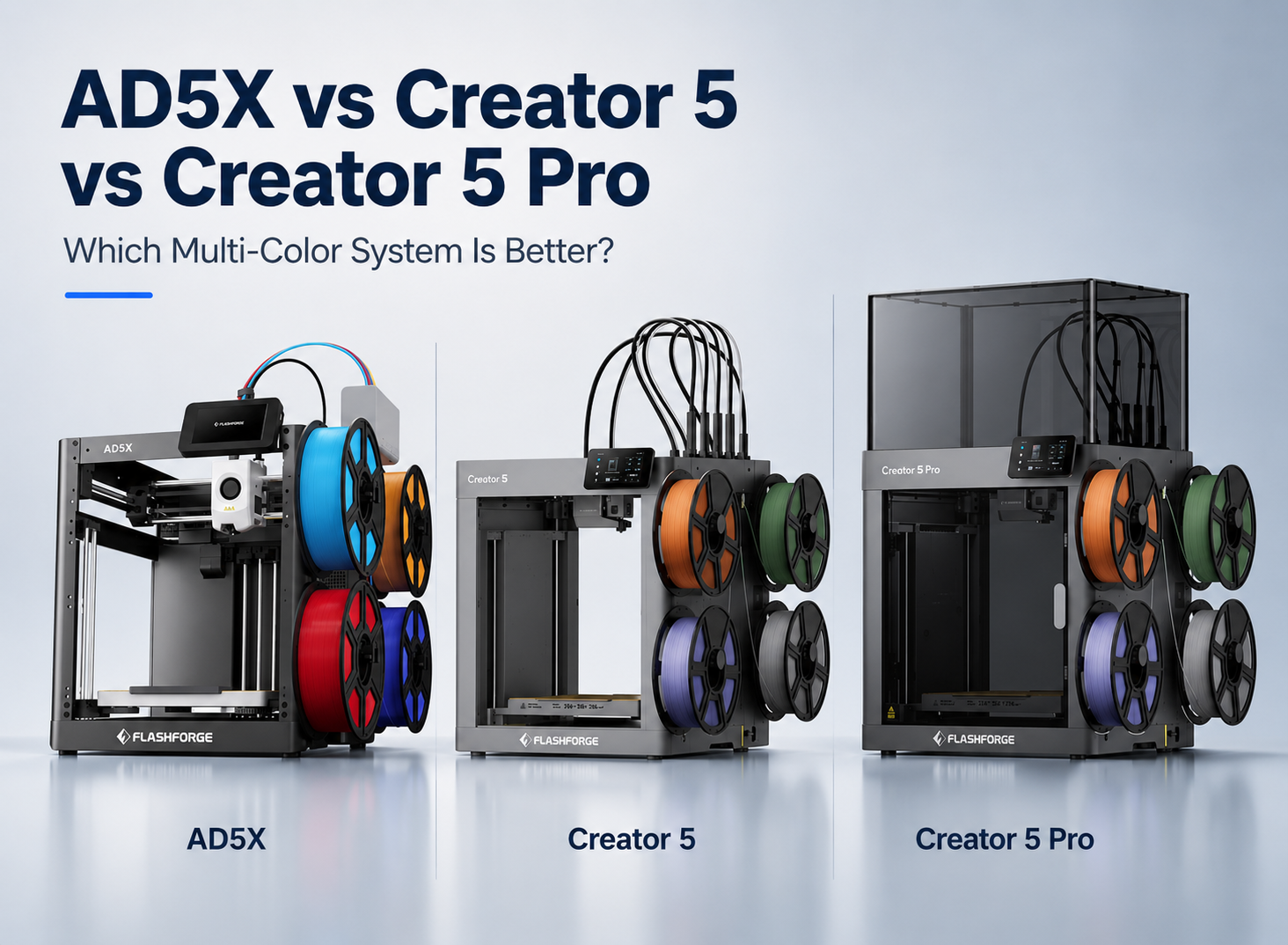
Student robotics, Arduino projects, and small DIY robots often require repeated printing of brackets, sensor mounts, and enclosures, so fast iteration and reliable output are especially important. The Flashforge Adventurer 5M features auto leveling, a quick-release nozzle, and a CoreXY structure, making it easier to move quickly into the next round of testing after design changes. With a 0.6 mm nozzle, it also supports TPU, PLA-CF, and PETG-CF, providing more material options for later functional prototypes.
Best for Engineering Material Robotics Parts
When gears, load-bearing brackets, or robot joints move into functional testing, material stiffness, heat resistance, and mechanical performance become more important than appearance alone. The Flashforge Creator 5 Pro features an actively heated chamber up to 65°C and supports engineering materials such as PA-CF, PAHT-CF, and PPA-CF, making it better suited to producing and testing load-bearing structures and mechanical parts.
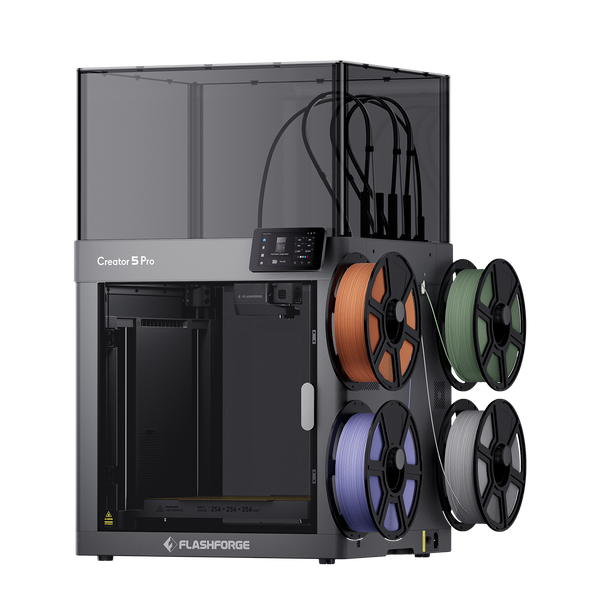
Flashforge Creator 5 Pro 4-Toolheads Enclosed Multi-Color 3D Printer | 500% Faster, Zero Purge Waste
Best for Multi-Material and Flexible Robotics Parts
Robot grippers and flexible contact structures often require different material properties, while printing parts separately and assembling them can add extra steps to prototype testing. The Flashforge Creator 5 uses four independent toolheads and supports materials including TPU, PVA, and BVOH, making it more suitable for flexible parts, multi-material structures, and complex robotics prototypes that require soluble supports.
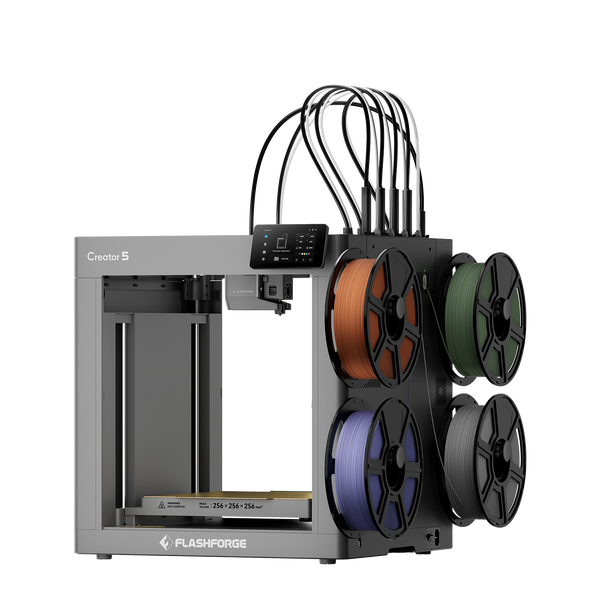
Flashforge Creator 5 4-Toolheads Multi-Color 3D Printer | 500% Faster, Zero Purge Waste
Common 3D Printed Parts for Robotics Prototyping
3D printing is used for both structural and functional robot parts, but each part places different demands on the printer. The table below summarises the main requirements before the sections look at each part in more detail.
| Part | Typical Use | Key Requirements |
|---|---|---|
| Brackets | Motors and structural connections | Accuracy, strength |
| Sensor Mounts | Cameras and sensors | Positioning, dimensional consistency |
| Enclosures | Electronics and wiring | Fit, build volume |
| Gears | Motion and transmission | Accuracy, shaft fit, wear resistance |
| Grippers | Object handling | TPU, flexibility, multi-material support |
| Jigs | Assembly and positioning | Accuracy, repeatability |
These requirements help explain why different robotics parts may need different materials, tolerances, and printing strategies. The following sections look at how each part is used during prototyping.

Brackets and Structural Supports
A motor bracket for a small wheeled robot may only need to hold alignment during early testing, while a load-bearing arm support must handle repeated force without shifting. 3D printing makes it easy to adjust hole spacing, wall thickness, or mounting angles as the frame design changes.
Sensor Mounts and Enclosures
Sensor placement often affects how well a robot works. For example, a camera mount may need a precise angle, while an ultrasonic sensor holder must keep the sensor at a fixed position relative to the chassis. Custom enclosures can also be shaped around control boards, wiring, and access ports instead of forcing electronics into a standard box.
Gears and Moving Components
Gears are useful for testing motion, spacing, and transmission layouts before committing to final hardware. A prototype gearbox, for instance, can reveal whether shaft spacing or tooth engagement needs adjustment. As testing becomes more demanding, material choice and dimensional consistency become more important.
Grippers and Flexible Parts
Not every robotic part should be rigid. A gripper may use a stiff body with softer TPU pads to improve contact with delicate or irregular objects. Flexible fingers, bumpers, or wheels can also be printed when the design needs controlled deformation rather than maximum stiffness.
Jigs and Assembly Fixtures
Some of the most useful printed parts never become part of the robot itself. A custom jig can hold a bracket at the correct angle during assembly, position holes for drilling, or keep repeated components aligned while they are being tested. Because these tools are easy to revise, they can evolve alongside the robot design.
Tips for Better Robotics Prototyping Results
Good print quality alone does not guarantee a useful robotics prototype. Material choice, tolerances, orientation, and testing strategy all affect how well a printed part performs in the final assembly.
Match Materials to Part Function
Choose materials based on what the part actually needs to do. PLA may be enough for early sensor mounts or enclosure checks, while gears and load-bearing brackets can benefit from tougher materials such as nylon or carbon-fiber-reinforced filament. TPU is a better fit for gripper pads, bumpers, and other flexible contact parts.
Allow for Tolerances and Assembly Fit
When creating 3D models for printing, CAD dimensions do not always translate into a perfect physical fit. Shaft holes, screw clearances, snap fits, and mating parts often need small allowances, especially when printed components must connect with bearings, motors, or metal hardware. Testing a small fit sample first can save time on larger parts.
Optimise Part Orientation and Supports
Print orientation affects both strength and surface quality. A bracket loaded across weak layer lines may fail sooner, while poor support placement can leave rough surfaces around holes or moving interfaces. Rotate parts to improve load direction and keep supports away from critical mating surfaces where possible.
Test Critical Parts Before Full Production
Check the parts most likely to affect fit or movement before printing the complete assembly. Useful early tests include:
- Gear engagement and shaft fit
- Motor bracket hole alignment
- Gripper movement and contact
- Sensor mount positioning
Validating these features first makes it easier to identify design problems before more time and material are committed to the full prototype.
Conclusion
The best 3D printer for robotics depends on the parts you need to prototype. Gears, brackets, sensor mounts, enclosures, grippers, and jigs all place different demands on accuracy, materials, support performance, and build volume.
For early projects, reliable printing and fast iteration may be enough. As prototypes move into functional testing, nylon and carbon-fiber compatibility, TPU, multi-material printing, and more advanced support options become increasingly useful. Matching the printer and material to the role of each part can make robotics prototyping faster, more practical, and easier to refine.
FAQ
What Type of 3D Printer Is Best for Robotics?
For most robotics prototyping, an FDM 3D printer is the most practical choice because it is affordable, versatile, and suitable for functional parts. The best model depends on whether you need higher accuracy, engineering materials, TPU, multi-material printing, or a larger build volume.
What Is the Best Filament for 3D Printed Robot Parts?
There is no single best filament for every robot part. PLA works well for early fit checks and simple mounts, PETG suits many general functional parts, nylon is useful for tougher mechanical components, carbon-fiber-reinforced filaments can provide greater stiffness, and TPU is useful for flexible grippers or contact surfaces.
Can You 3D Print Gears for Robots?
Yes. 3D printed gears are useful for prototypes and can also work in some light-duty robotic applications. Good results depend on accurate tooth geometry, proper shaft fit, suitable print orientation, and a material that can handle the expected load and wear.
Is PLA Strong Enough for Robotics?
PLA is strong enough for many early prototypes, including sensor mounts, enclosures, brackets, and fit checks. For parts exposed to repeated loads, impact, heat, or wear, materials such as PETG, nylon, or reinforced filaments are usually more suitable.
How Accurate Does a 3D Printer Need to Be for Robotics?
It depends on the part. Sensor mounts, gears, bearing fits, and mating components require better dimensional consistency than simple covers or jigs. For most projects, repeatable dimensions and correctly designed tolerances matter more than chasing the smallest possible accuracy specification.
Do You Need a Large 3D Printer for Robotics?
Not for most robotics projects. Small and medium printers can handle many brackets, gears, sensor mounts, and grippers, while a larger build volume becomes more useful for full-size enclosures, frame sections, or assembly jigs that would otherwise need to be split into several parts.