


FDM 3d printer filament affects more than color. It shapes printability, surface finish, strength, flexibility, heat resistance, and outdoor durability.
PLA, PETG, ABS, TPU, nylon, and polycarbonate behave very differently. This guide compares their properties, uses, hardware requirements, and storage needs so you can match the material to both the project and the printer.
What Is FDM 3D Printer Filament?
FDM filament is a continuous strand of thermoplastic. A printer feeds it into a heated nozzle, deposits the softened material along a programmed path, and builds the object one bonded layer at a time.
What Is FDM Filament Made Of?
Most filament begins as plastic pellets. Manufacturers may add pigments, stabilizers, impact modifiers, plasticizers, fibers, or decorative particles before extruding the blend into a precisely sized strand.
Those additives matter. Impact-modified PLA behaves differently from standard PLA, while carbon-fiber nylon combines a moisture-sensitive polymer with abrasive chopped fibers. The polymer name is only a starting point; formulation and color can also alter flow and temperature requirements.
What Filament Diameter Do FDM 3D Printers Use?
Most current desktop printers use 1.75 mm filament. Some professional and older systems use 2.85 mm.
The sizes are not interchangeable. Extruder gears, the filament path, the hotend, and the slicer profile must match the diameter. Inconsistent thickness can cause alternating under- and over-extrusion.
What Are the Main Types of FDM 3D Printer Filament?
The easiest way to compare 3d printer filament is by purpose. Some materials prioritize simple printing, while others are chosen for toughness, flexibility, heat resistance, outdoor durability, or removable supports.

PLA for Easy Printing and General-Purpose Models
PLA is the usual starting point. It prints at moderate temperatures, warps relatively little, and reproduces fine detail well. Common uses include models, organizers, prototypes, and toys.
Heat is its main weakness. A PLA part that performs well indoors may soften in a hot vehicle or near a heater. Choose it when ease of use and appearance matter more than high-temperature durability. Flashforge’s complete guide to 3D printer filament types provides a broader material overview.
PETG for Tough and Durable Functional Parts
PETG offers more toughness and moisture resistance than standard PLA without immediately requiring an enclosed machine. It suits brackets, covers, workshop accessories, and everyday repairs.
Excess heat can increase stringing, while an overly compressed first layer may bond too strongly to the build surface. Once tuned, PETG is a practical material for general functional printing.
ABS and ASA for Durable and Outdoor Parts
ABS suits impact-resistant housings, fixtures, and machinable prototypes. ASA offers similar performance with better sunlight and weather resistance, making it stronger for signs, mounts, and exterior housings.
Both shrink as they cool, so an enclosure and stable airflow help prevent lifted corners and layer cracking. NIOSH also recommends material selection, source control, and ventilation to reduce exposure to ultrafine particles and chemical emissions.
TPU and TPE for Flexible Components
Rigid plastic is not always desirable. TPU and TPE work well for grips, seals, gaskets, protective bumpers, soft hinges, and vibration-damping feet.
Softer grades are harder to feed because they can buckle in an open filament path. Direct-drive extrusion, moderate speed, limited retraction, and dry filament usually produce more reliable results. Damp TPU often announces itself through stringing, bubbles, or a rough surface.
Nylon, Polycarbonate, and Other Engineering Filaments
Nylon is tough and fatigue-resistant, which makes it useful for clips, gears, hinges, and parts that flex repeatedly. Polycarbonate is selected for stronger, more heat-resistant components, although it demands higher temperatures and better environmental control.
Preparation matters. Nylon absorbs moisture quickly; polycarbonate often needs strong bed adhesion and an enclosure. Controlled chamber temperature can also reduce stress in larger parts.
Carbon-Fiber, Glass-Fiber, and Other Composite Filaments
Composite filaments contain short fibers or particles in a base polymer. Carbon and glass fibers can improve stiffness and dimensional stability; wood, stone, metal, and glow additives mainly change appearance.
Do not judge a composite by the filler alone: PLA-CF and PA-CF still behave differently. Abrasive additives can wear brass nozzles, so hardened hardware is safer.
Support and Decorative Filaments
PVA and BVOH dissolve in water, allowing supports to be removed from internal channels, cavities, and complex overhangs. Breakaway materials are useful when dissolving the support is impractical. Silk, wood-filled, dual-color, and color-changing filaments focus mainly on visual effect.
Multi-material work also depends on switching. The Flashforge Creator 5 uses four independent toolheads, keeping different colors or compatible materials loaded instead of repeatedly passing them through one nozzle. This reduces purging and color carryover in workflows involving PLA, PETG, TPU, PVA, or BVOH. Flashforge lists high-speed performance up to 600 mm/s, though usable speed still depends on flow rate, material, model geometry, and quality settings.
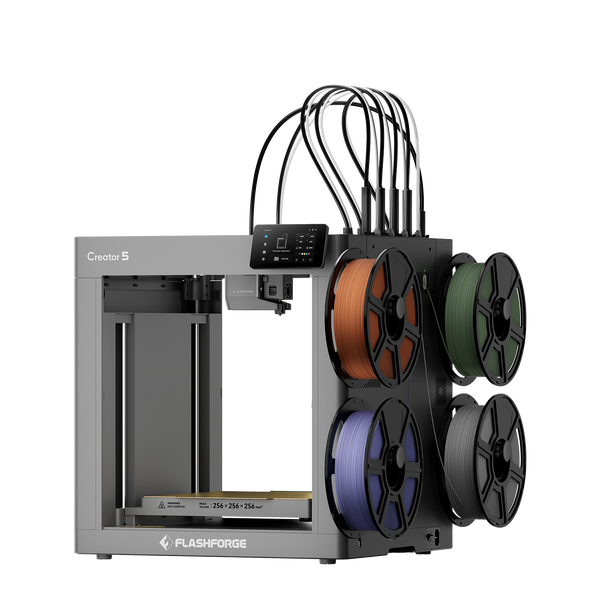
Flashforge Creator 5 4-Toolheads Multi-Color 3D Printer | 500% Faster, Zero Purge Waste
FDM Filament Comparison Table
| Filament | Best Suited To | Main Advantage | Main Limitation |
| PLA | Models and prototypes | Easy printing and clean detail | Low heat resistance |
| PETG | Everyday functional parts | Toughness and moisture resistance | Stringing may need tuning |
| ABS | Housings and fixtures | Impact and heat resistance | Warping and emissions control |
| ASA | Outdoor components | UV and weather resistance | Benefits from an enclosure |
| TPU/TPE | Grips, seals, flexible parts | Elasticity | Feeding and moisture sensitivity |
| Nylon/PC | Engineering parts | Toughness and heat performance | High printing requirements |
| Fiber composites | Rigid tools and prototypes | Stiffness | Abrasive to standard nozzles |
| PVA/BVOH | Complex supports | Dissolves after printing | Highly moisture-sensitive |
The table summarizes typical behavior rather than fixed specifications. Exact performance varies with the formulation, manufacturer, color, printing profile, and part design.
How to Choose the Right Filament for Your Project
Begin with the finished part, not the spool label. Function, environment, hardware, and material combinations should narrow the choice before color or finish.
Choose Filament Based on Part Function and Performance
A display model needs detail. A snap-fit clip needs toughness. A gasket must compress and recover.
Identify the dominant requirement: stiffness, impact resistance, flexibility, fatigue life, heat tolerance, or appearance. Geometry and orientation matter too; loads that pull layers apart can expose a weaker direction.
Material alone cannot compensate for poor design. Wall thickness, rounded transitions, infill direction, and the placement of holes or fasteners may affect the final result as much as the polymer itself.
Choose Filament Based on the Use Environment
Ask where the object will spend its life. PLA is usually adequate for indoor models. PETG handles many damp, everyday settings. ASA is more suitable outdoors, while sustained heat or mechanical stress may justify nylon, PC, or another engineering polymer.
The printing environment also counts. Shrink-prone materials perform better away from drafts, while higher-emission workflows need suitable ventilation. NIOSH treats emissions, hot surfaces, moving parts, and electrical risks as one safety plan.
Choose Filament Based on Printer Compatibility and Printing Difficulty
Before choosing a 3d printer for sale, check its nozzle and bed temperatures, nozzle material, extruder design, enclosure, chamber control, and recommended build surface against the filaments you plan to use.
For frequent engineering-material work, the Flashforge Creator 5 Pro combines four independent toolheads with a fully enclosed frame and active chamber heating up to 65°C. Its nozzle reaches up to 320°C, while the heated bed reaches up to 120°C. That controlled platform is intended for multi-material prototypes, fixtures, housings, and small batches using materials such as ABS, ASA, PA, PC, and fiber-reinforced grades.
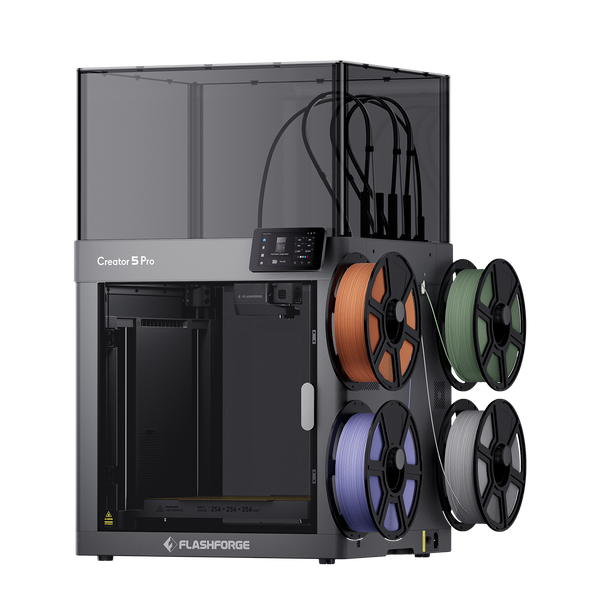
Flashforge Creator 5 Pro 4-Toolheads Enclosed Multi-Color 3D Printer | 500% Faster, Zero Purge Waste
Choose Filament Based on Color and Multi-Material Requirements
Color can identify controls, mark assembly zones, display labels, or improve an educational model. Material combinations go further: a rigid body may include a flexible grip, or a complex part may use soluble support.
Compatibility has two sides: workable temperature and cooling ranges, plus adequate bonding. Successful printing does not automatically create a durable interface. Before starting a long job, test a small joint made from the same materials and printed in the same orientation.
Tips for Storing and Printing FDM Filament
Many apparent material failures begin with moisture, incompatible hardware, or an untested profile. A few checks can prevent an overnight failure.
Match Nozzle, Bed, Extruder, and Enclosure to the Filament
Use a hardened nozzle for abrasive composites and a constrained feed path for flexible filament. Shrink-prone materials need a warm, draft-free environment; PETG may need a release layer on surfaces where it bonds too aggressively.
Never raise temperatures beyond the printer’s rating. The heater, thermistor, nozzle, bed, and surrounding components must all be suitable.
Store and Dry Filament to Reduce Moisture-Related Problems
Sealed bags or containers with desiccant suit many opened spools, but nylon, PVA, BVOH, and TPU need stricter moisture control.
Popping, bubbles, rough walls, brittle filament, excessive stringing, and inconsistent extrusion are common warning signs. Dry the spool according to its manufacturer’s instructions, then return it to sealed storage. Flashforge’s guide to filament dryness and humidity explains why exposed filament can lose print quality and absorb moisture again after drying.

Adjust Temperature, Speed, Cooling, and Retraction Settings
A validated profile is a starting point, not a guarantee. Weak layers can indicate insufficient heat or excessive cooling. Stringing may come from temperature, retraction, or simply wet filament. At high speed, the hotend must melt more plastic per second, so flow capacity and high-speed filament matter as much as motion speed.
Change one setting at a time. Otherwise, a successful result will be difficult to repeat.
Test New Filament Before Starting a Long Print
A small calibration model can prevent hours of wasted printing. Test temperature, flow, retraction, bridges, and first-layer adhesion before committing to a large part.
Better still, use a sample that resembles the final job. A bracket test should include similar walls, holes, and load direction; a decorative model should reproduce the same fine details and overhangs. Save successful settings with the exact material, color, nozzle, and drying condition.
Conclusion
No filament is best for every job. The best 3d printer is the one whose hardware matches the materials, environment, and parts you plan to make. PLA suits easy modeling, PETG adds toughness, ASA handles outdoor use, TPU provides flexibility, and engineering materials support more demanding parts.
Define the part’s function, evaluate its environment, confirm printer compatibility, and test the actual spool. Good storage and careful tuning then protect the performance you selected.
FAQ
What Is FDM Printing Good For?
FDM printing suits prototypes, household parts, jigs, fixtures, toys, educational models, enclosures, and customized low-volume products. Its material range supports both visual and functional work.
How Much Filament Does a Typical 3D Print Use?
There is no fixed amount. Model size, wall count, infill, supports, purge structures, and material density all affect consumption. The slicer’s weight estimate is the most useful figure for a specific job.
Does Print Orientation Affect the Strength of FDM Parts?
Yes. FDM parts can resist loads differently along and across their layer lines. Orient functional components so the main force travels through continuous material rather than pulling layers apart.
Does Filament Color Affect Print Quality or Material Performance?
It can. Pigments and additives may change flow, cooling, opacity, heat absorption, and mechanical behavior. Test a new color before using it for a tolerance-critical or load-bearing component.
Is FDM 3D Printer Filament Safe for Food Contact?
Do not assume so. The base polymer, additives, colorants, intended use, printer contamination, surface condition, and cleaning method all matter. FDA guidance states that food-contact substances must be authorized for their intended use and comply with the limits of that authorization.
Can Failed Prints and Filament Scraps Be Recycled?
Some clean, single-material waste can be shredded and re-extruded, but mixed polymers, adhesives, fillers, and contamination make the process less predictable. Local recycling programs may not accept printed scraps, so check the facility’s rules before placing them in a household recycling bin.