


High-speed FDM 3D printers can reduce lead times and help users complete more parts in a single day, but maximum print speed alone does not reflect real-world performance. A printer rated at 600 mm/s will not maintain that speed through every wall, corner, overhang, or short toolpath. Actual print time also depends on acceleration, motion stability, hotend flow, cooling, filament behavior, and slicer settings. This guide explains how high-speed FDM printing works, what qualifies as high speed, how it compares with resin, SLS, and MJF, and what to consider when choosing a printer for prototyping, production, education, or everyday projects.
What Is a High-Speed FDM 3D Printer?
How Does a High-Speed FDM 3D Printer Work?
The basic FDM 3D printing process remains the same: filament is melted and deposited layer by layer. What changes is the level of control. A rigid motion system handles rapid direction changes, while a high-flow hotend supplies enough material to match the movement. Vibration compensation and flow calibration help reduce ringing, uneven corners, and weak extrusion during faster prints.
What Print Speed Is Considered High Speed?
There is no universal industry standard for high-speed FDM printing. As a practical reference, Raise3D states that standard FFF printers typically operate at 50–150 mm/s, while its Hyper FFF system uses higher speed levels above this range. This makes roughly 150 mm/s and above a useful practical reference for high-speed FDM rather than an official cutoff.
Maximum speed alone, however, does not determine real print time. Acceleration, volumetric flow, cooling, filament properties, and model geometry can all limit actual printing speed, so sustained performance matters more than the headline figure.
Advertised Speed vs. Real-World Print Speed
The number on the product page rarely represents the speed used throughout an entire print. Corners, small holes, overhangs, and outer walls require the printer to slow down. A simple storage box may benefit greatly from high-speed infill, while a detailed figurine spends more time on short movements and fine surfaces. Total completion time is therefore more meaningful than maximum speed alone.
| Factor | Advertised Speed | Real-World Effect |
| Speed | Maximum rated value | Often reached only on simple paths |
| Acceleration | Separate specification | Affects how quickly target speed is reached |
| Geometry | Not reflected | Details and corners slow printing |
| Print time | Not shown by speed alone | Better reflects actual productivity |
Real-world speed depends on acceleration, geometry, flow, and print settings—not the maximum rating alone.
High-Speed vs. Standard FDM 3D Printers
For occasional hobby projects, a standard 3D printer may provide enough performance at a lower cost. High-speed models are better suited to repeated prototyping, classroom use, print farms, and small-batch production. Their stronger frames, higher-flow hotends, improved cooling, and motion-control software help maintain consistency under heavier workloads. The real advantage is not simply faster movement, but more finished parts within the same working day.
| Feature | Standard FDM | High-Speed FDM |
| Speed | Moderate | Higher sustained speed |
| Acceleration | Lower | Higher |
| Flow | Standard | Higher-flow hotend |
| Best for | Hobby use | Frequent or batch printing |
| Main benefit | Lower cost | Higher daily output |
High-speed FDM is most useful when faster turnaround and higher daily output matter.
How Does High-Speed FDM Compare With Other 3D Printing Technologies?
High-speed FDM suits fast functional parts, while resin favors fine detail and SLS or MJF handles larger production batches.
High-Speed FDM vs. Resin 3D Printing
Resin printing produces finer details and smoother surfaces, making it suitable for miniatures, jewelry, and display models. High-speed FDM is generally better for larger prototypes and functional parts because thermoplastic materials are easier to handle and usually require less post-processing.
High-Speed FDM vs. SLS 3D Printing
SLS uses polymer powder and can print complex nylon parts without separate supports. It performs well for dense production batches, but high-speed FDM is usually faster and more affordable when only a few prototypes, fixtures, or replacement parts are needed.
High-Speed FDM vs. MJF 3D Printing
MJF is designed for industrial batch production with consistent mechanical properties. However, its equipment and processing requirements make it less practical for frequent design changes, whereas high-speed FDM allows teams to test revised parts quickly and at a lower cost.
High-Speed FDM vs. Resin, SLS, and MJF at a Glance
The main differences come down to detail, production scale, material workflow, and cost.
| Technology | Best For | Main Strength | Main Limitation |
| High-Speed FDM | Prototypes, fixtures, small batches | Fast and flexible | Less fine detail |
| Resin | Miniatures, jewelry, display models | High detail | More post-processing |
| SLS | Complex nylon parts | No support structures | Higher cost |
| MJF | Industrial batch production | Consistent batch output | Less flexible for frequent revisions |
When Is High-Speed FDM the Better Choice?
High-speed FDM works best when parts change frequently, quantities remain limited, and waiting for an outsourced production batch would take longer than printing in-house. It offers a useful balance of speed, material flexibility, simple operation, and accessible operating costs.What Are the Benefits of High-Speed FDM Printing?
High-speed FDM printing reduces the time from design to finished part. Its main benefits are faster iteration, higher daily output, and shorter production lead times.Shorten Prototyping and Design Iteration Cycles
This is one of the clearest advantages of high-speed FDM. When a prototype prints faster, designers can test dimensions, assembly, fit, and basic function earlier, then return to CAD and revise the model without waiting until the next day. Several iterations may be completed within the same development cycle, helping teams identify problems sooner.Increase Daily Printing and Production Capacity
Higher speed also matters when printers run repeatedly throughout the day. Shorter jobs free the machine sooner, allowing more parts to enter the queue without adding another printer.For print farms, classrooms, and small production teams, these time savings can accumulate across many jobs and noticeably increase daily output.Reduce Lead Times for Custom and Small-Batch Parts
High-speed FDM is useful for custom parts that change from order to order. Faster turnaround helps replacement parts, personalized products, and short production runs move from file preparation to finished part with less waiting.Improve Workflow Efficiency and Lower the Cost per Usable Part
Shorter print cycles reduce machine occupancy and make scheduling more flexible. When higher speed is combined with reliable extrusion and low failure rates, the same equipment can produce more usable parts over time, spreading machine and labor costs across a larger output.What Are High-Speed FDM 3D Printers Used For?
High-speed FDM 3D printers are used wherever shorter production cycles, repeatable quality, and flexible material choices matter—from early prototypes to on-demand manufacturing.

Rapid Prototyping and Product Development
High-speed FDM shortens the feedback loop between design and testing, allowing teams to evaluate more iterations before committing to tooling. Several enclosure or bracket versions can be printed and compared in one day, making it easier to correct fit, assembly, or structural issues early.
Jigs, Fixtures, and Functional Parts
Production tools require accurate dimensions, dependable layer bonding, and stable thermal conditions, not just faster output. The Flashforge Creator 5 Pro combines four independent toolheads with a 65°C actively heated chamber, a 320°C nozzle, a 120°C print bed, a maximum print speed of 300 mm/s, a maximum travel speed of 600 mm/s, acceleration up to 30,000 mm/s², and a maximum flow rate of 32 mm³/s, making it well suited to jigs, fixtures, multi-material functional parts, and small-batch engineering production.
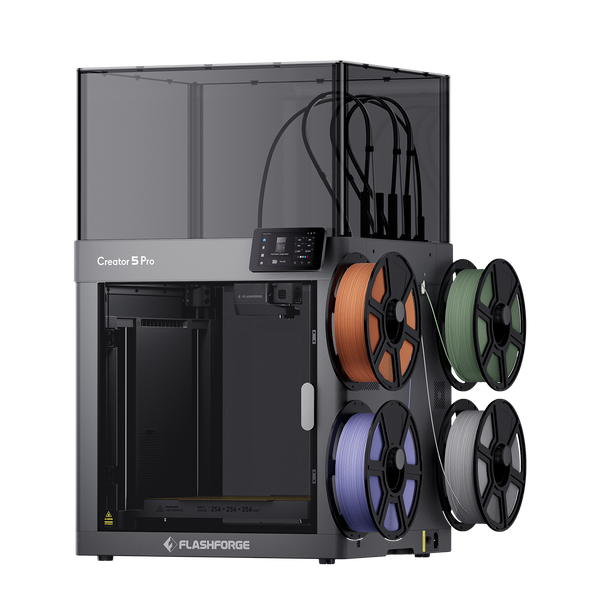
Flashforge Creator 5 Pro 4-Toolheads Enclosed Multi-Color 3D Printer | 500% Faster, Zero Purge Waste
Customized Products and Small-Batch Production
Short production runs often change from one order to the next. A shop producing personalized signs, colored product samples, or multi-material accessories can use the Flashforge Creator 5 to keep different materials ready across four independent toolheads, reducing repeated loading and switching delays.
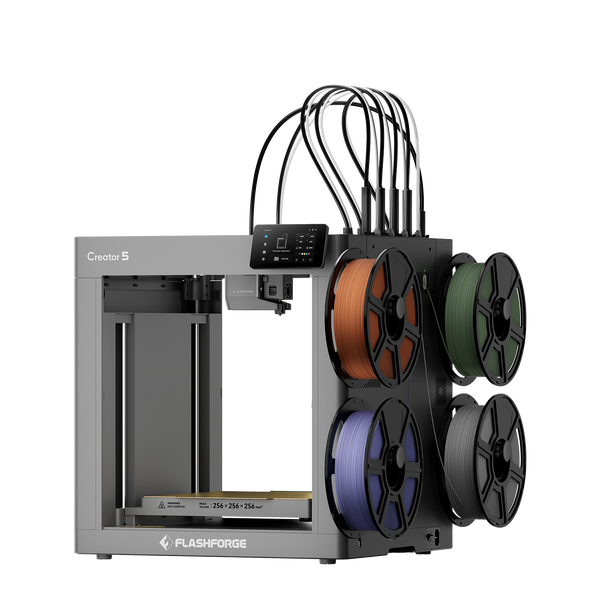
Flashforge Creator 5 4-Toolheads Multi-Color 3D Printer | 500% Faster, Zero Purge Waste
Education, Research, and Design Testing
High-speed FDM helps schools and laboratories complete more projects with the same equipment. Faster turnaround supports classroom demonstrations, iterative robotics work, experimental models, and side-by-side design testing without creating long printer queues.
Print Farms and On-Demand Manufacturing
Daily output matters more than one impressive speed figure in a print farm. Saving even a few minutes on each order can create substantial extra capacity across dozens of machines, especially when remote management, reliable calibration, and interruption detection keep production moving.
How to Choose the Right High-Speed FDM 3D Printer
The right FDM 3D printer should match your usual model size, materials, and production workflow rather than simply offer the highest advertised speed.

Choose Speed and Acceleration Based on Typical Model Size
Model size should guide how much speed really matters. Large parts such as storage bins, cosplay sections, or enclosure panels have longer toolpaths, so the printer has more room to reach and maintain higher speeds. Small gears or detailed figurines rely more on acceleration and controlled direction changes, where a 600 mm/s rating may have limited practical impact.
Compare Flow Rate, Cooling, and Motion Stability
High speed only works when extrusion and motion can keep up. A high-flow hotend must melt enough filament, cooling must solidify each layer quickly, and the frame must stay stable during rapid movement. For example, fast infill on a large prototype can expose under-extrusion or ringing if any of these systems become a bottleneck.
Choose an Open or Enclosed Design Based on Print Materials
Material choice often determines the right machine structure. Open printers work well for PLA and many PETG projects, such as organizers, toys, and basic prototypes. ABS, ASA, PC, PA, and some fiber-reinforced filaments benefit from a more stable thermal environment, making an enclosure—and for demanding engineering parts, active chamber heating—more useful.
Choose Single or Multiple Toolheads Based on Your Workflow
Not every workflow needs multiple toolheads. A single-toolhead printer is usually enough for brackets, household parts, and other single-material jobs. Multi-color models, soluble supports, or parts combining rigid and flexible materials benefit more from independent toolheads because material changes require less loading, unloading, and purging.
Evaluate Calibration, Reliability, and Operating Costs
Daily usability matters as much as headline specifications. Automatic leveling, vibration compensation, flow calibration, and filament monitoring can reduce setup time and failed prints, especially when several jobs run each day. When buying an FDM 3D printer, also consider nozzle replacement, wasted filament, maintenance, and downtime, since these costs can outweigh a small difference in purchase price over time.
Tips for Successful High-Speed FDM Printing
Successful high-speed FDM printing requires balanced material, flow, cooling, and speed settings—not simply the fastest profile.
Start With a Tested Material Profile
Begin with a validated material profile in Flash Studio Desktop for the specific filament, nozzle, and printer. A stable baseline reduces problems such as under-extrusion, weak layer bonding, stringing, and poor surface quality before higher speeds are introduced.
Increase Speed and Flow Gradually
Raise print speed in small steps while checking whether the hotend can maintain the required flow. If gaps, rough top layers, or weak walls appear, reduce the speed or adjust temperature, layer height, and extrusion settings.
Match Temperature and Cooling to the Filament
Choosing a high-speed filament does not remove the need to match temperature and cooling to the material. PLA generally benefits from strong cooling, while ABS, ASA, PC, and PA require more controlled airflow and stable ambient temperatures to reduce warping and layer separation.
Test Critical Features Before the Full Print
Print a small test section before committing to a large or time-sensitive model. Corners, bridges, thin walls, holes, and mating surfaces reveal whether the selected speed can maintain dimensional accuracy and reliable part strength.
Conclusion
Judge a high-speed FDM printer by the time it takes to produce a usable part, not by its highest advertised speed. Stable motion, sufficient filament flow, effective cooling, and reliable calibration matter more than a peak speed reached only on selected print paths.
For rapid prototyping, functional parts, customized products, and small-batch production, the right high-speed FDM 3D printer can shorten lead times and increase daily output without sacrificing usable quality.
FAQ
Does High-Speed FDM Printing Reduce Part Strength?
Not necessarily. Part strength depends on temperature, flow consistency, layer bonding, material, and print orientation; excessive speed can weaken parts if the hotend cannot melt enough filament or layers do not bond properly.
Does High-Speed FDM Printing Affect Dimensional Accuracy?
It can if acceleration, vibration, and extrusion are not well controlled. A rigid frame, vibration compensation, calibrated flow, and slower settings for outer walls and small features help maintain accuracy.
Do High-Speed FDM 3D Printers Use More Electricity?
They may draw more power while printing because of stronger motors, cooling fans, and higher heating demand. However, shorter print times can reduce the total energy used per completed part.
Are High-Speed FDM 3D Printers Louder Than Standard Printers?
They can be louder during rapid movement and cooling, especially at high acceleration. Frame design, enclosure quality, fan speed, and quiet-print modes all influence the actual noise level.
Can a Standard FDM Printer Be Upgraded for High-Speed Printing?
Some printers can be improved with firmware tuning, vibration compensation, better cooling, and a higher-flow hotend. Mechanical rigidity, motor capacity, and motion-system limits may still prevent them from matching a purpose-built high-speed printer.
Is a Larger Nozzle Better for High-Speed FDM Printing?
A larger nozzle can shorten print time by depositing wider and thicker lines, especially on large functional parts. The trade-off is reduced fine detail, and the hotend must still supply enough material to support the higher flow rate.