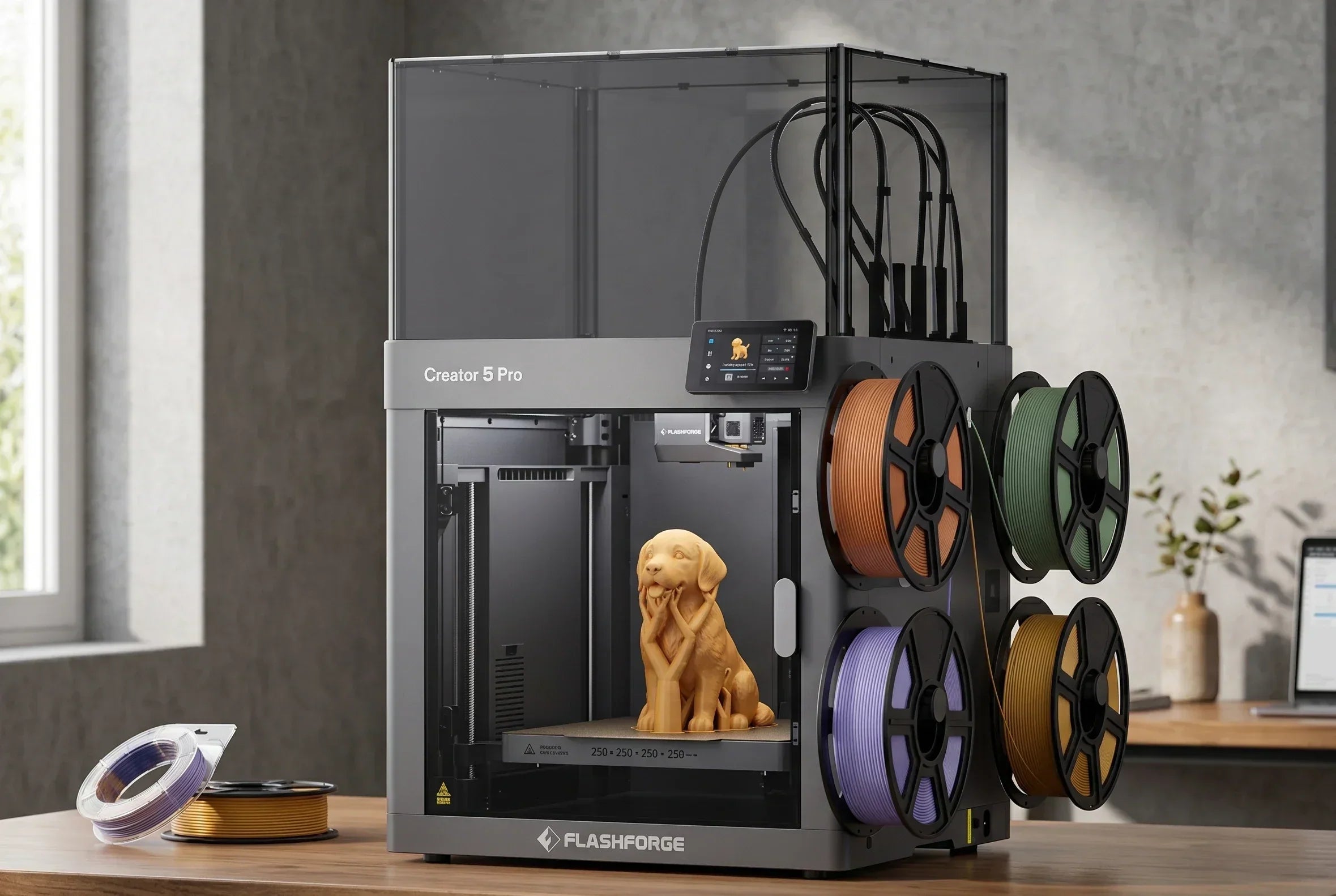



3D printing should accelerate product development. It turns digital designs into physical objects for quick validation. Ironically, the 3d printer often becomes the biggest bottleneck for many teams. Teams can only iterate two or three times a day. Complex parts require overnight queuing on the 3D printer. High speed FDM 3D printers like the Flashforge Creator 5 Pro 3D Printer are breaking this bottleneck. Today we will evaluate this FDM 3D printer and discuss practical ways to build an efficient prototyping workflow around fast 3D printers.
Why Fast 3D Printers Make Rapid Prototyping Critical in 2026
Prototyping needs in 2026 closely align with actual product development. They go far beyond simple visual displays. Teams demand a rapid rhythm of revising designs today, printing parts tomorrow, and testing the day after. This applies to consumer electronics shells, mechanical snaps, and small batch functional parts. Therefore, core metrics for 3D printers now include:
-
3D printing speed
-
Material changing efficiency
-
Cost of failed 3D prints
Industry data confirms the continuous expansion of 3D printing. Mordor Intelligence expects the global 3D printing market to reach $34.45 billion in 2026. This market will grow further to $69.26 billion by 2031. The compound annual growth rate sits at roughly 14.99%. Prototyping manufacturing is evolving from a niche tool into a standard production capability for product teams.
Tool-Changing Instead of AMS-Style Switching
The value of a tool-changing setup is very clear in product prototyping. Each filament occupies its own dedicated nozzle. The system eliminates long purging times and removes the need to flush massive amounts of material into a waste tower during filament swaps. For teams that frequently change colors, materials, or support strategies, this specific architecture keeps material waste per print incredibly low. This design makes the setup ideal for rapid, multi-round design iterations.
Near-Zero Purge Waste Changes the Economics
The most commonly overlooked cost in multi-material 3D printing is purge waste, rather than the initial cost of the FDM printer itself. Standard single-nozzle filament switching methods constantly generate waste during color and material transitions. Complex models can even result in waste that outweighs the actual part. A tool-changing system isolates each material to its own nozzle, which eliminates the process of clearing out the previous filament from the workflow.
This feature explains why the Creator 5 series is highly effective for prototyping teams looking to achieve zero purge waste. It provides a more economical way to produce multi-color display pieces, multi-material functional parts, and complex prints with dedicated support structures.
Faster Multi-Material Prototyping
The main goal of multi-material prototyping is to create parts that closely mimic final production products, rather than just showcasing technical capabilities. Projects often require different materials to work together seamlessly, such as:
-
Overmolded rigid and soft components
-
Clear viewing windows
-
Flexible snap-fit joints
-
Soluble support structures
A tool-changing 3D printer cuts down on waiting times, reduces nozzle cleaning cycles, and minimizes time lost to failed prints. This efficiency is especially important for small engineering teams that lack dedicated post-processing staff. Getting a usable part straight off the 3D printer bed accelerates the entire design verification process.
Why Small Teams Are Interested in Tool Changers
Small engineering teams want to avoid two main issues: rework and material waste. Tool-changing fdm 3d printers turn multi-material 3D printing into an everyday capability rather than an expensive specialty feature.This shift allows teams to conduct functional, aesthetic, and assembly verification more naturally.
For design studios, product development firms, and e-commerce R&D teams that frequently deliver client samples, this operational efficiency is far more valuable than raw speed specifications alone.
What Makes the Creator 5 Pro Different From Typical High-Speed Printers

High print speeds are common today, but true prototyping efficiency depends on balancing speed, stability, and material compatibility simultaneously. The Flashforge Creator 5 series combines four independent toolheads, a high-speed CoreXY motion system, automatic calibration, and engineering-grade material support. The engineering goal is clear: make high-speed 3D printing practical for serious development scenarios, rather than just printing simple PLA display models.
FlashSwap Multi-Toolhead Architecture
The Creator 5 utilizes the FlashSwap system featuring four independent toolheads. This setup focuses on achieving near-zero material waste during color and material transitions.
The true benefit comes from the configuration itself rather than the sheer number of nozzles. Each toolhead handles a specific filament or color independently, bypassing the inefficient cycles of frequent nozzle purging.
Independent Toolheads Reduce Downtime
Independent nozzles benefit prototype development by significantly cutting down on material switching times. When one nozzle focuses exclusively on support material and another handles the main body filament, the print job runs like an organized industrial workflow.
This setup improves the continuity of multi-round testing. It is especially useful for fast-paced product development schedules that require multiple iterations within a single day.
Active Chamber Heating for Engineering Materials
A major upgrade on the Flashforge Creator 5 Pro is the active heated chamber that reaches up to 65°C. The system includes an H13 HEPA and activated carbon filtration setup to ensure stable printing with industrial filaments like ABS, ASA, PC, and PA.
These capabilities are critical during the prototyping phase. Engineering materials closely match final production parts, making them ideal for verifying dimensional stability, heat resistance, and assembly strength.
Why CoreXY Matters for Prototype Production
The value of a CoreXY motion system extends beyond impressive speed benchmarks. This mechanical design handles high acceleration and frequent direction changes efficiently, allowing the FDM printer to deliver fast turnaround times while maintaining sharp part contours.
For prototyping teams, this stability translates to shorter wait times. It also reduces instances where running a 3D printer at maximum speed causes ringing artifacts that force you to reprint the part.
Faster Color Changes Without Long Purges
Slow color changes usually occur because clearing the nozzle takes too much time. The tool-changing approach of the Creator 5 completely avoids this step.
If your prototype requires distinct color zoning, local labels, a mix of clear and opaque sections, or branded display elements, this switching method is highly efficient. It fits perfectly into workflows that demand constant design revisions.
A Practical Prototype Workflow Using the Creator 5 Pro
An effective prototyping 3D printer does more than produce visual models. It supports your entire workflow from initial sketch to functional assembly. The advantage of the Creator 5 Pro is its versatility, serving as a fast tool for rough drafts and a reliable system for engineering-grade material validation. This capability allows one FDM printer to cover a much longer section of your development cycle.
Starting With Fast Draft Iterations
The goal of the first prototype round is rapid validation of form, fit, and key dimensions, rather than perfection. The Creator 5 series features print speeds up to 600 mm/s and reliable auto-leveling, which condenses proof-of-concept stages into short print cycles.
When teams want to accelerate their hardware iterations, the most reliable approach is to verify mechanical layouts with standard filaments first, saving fine details for later versions.
Using Different Materials in One Prototype
Many functional prototypes need to showcase rigidity, elasticity, and specific aesthetic finishes in the very first iteration. Multi-material capabilities are incredibly practical for these needs. The Creator 5 prints multi-material structures in a single job, allowing you to create complex combinations like:
-
Rigid enclosures with overmolded soft rubber buttons
-
Solid housings with integrated transparent viewing windows
-
Structural parts with embedded, removable alignment jigs
This approach eliminates secondary assembly steps and ensures your test results closely mimic the final mass-produced product.
Soluble Supports for Complex Parts
Complex internal channels, deep overhangs, and thin cantilevered features often present challenges during support removal. Using soluble support materials allows teams to minimize post-processing time and successfully evaluate complex geometries early in the design phase.
This capability is valuable for prototypes that require strict assembly tolerances. It prevents the edge deformation and surface damage that often occur when manually breaking away standard supports.
Functional Testing Before Final Production
The prototyping process ends when a part enters actual functional testing, rather than when the 3D printer finishes its cycle. The engineering material compatibility of the Creator 5 Pro allows teams to perform stress, heat, and fitment checks early in the cycle. This early validation helps identify structural flaws long before investing in expensive injection tooling.
This step reduces downstream revision costs and aligns with realistic product development timelines.
Reducing Design Revision Cycles
Fast 3D printing turns guesswork into physical proof. When printing, inspecting, measuring, and re-printing form a tight feedback loop, design adjustments depend on physical sample data rather than subjective opinions.
This efficiency explains why the Creator 5 Pro fits small development teams so well. It lowers the cost of individual design failures, making comprehensive version testing accessible and affordable.
Where the Creator 5 Pro Fits in Real Product Development
High-speed 3D printing solves time-related challenges. Tool-changing architecture and engineering-grade material support solve a different issue, ensuring your physical prototype accurately represents the final product. The Creator 5 Pro works best during the mid-stage of development, bridging the critical gap between initial proof-of-concept and final engineering validation.
Consumer Product Prototypes
Consumer product prototypes require excellent aesthetics, precise color matching, and a premium assembly feel. The multi-color 3D printing capabilities of the Creator 5 are ideal for producing front panels, enclosures, functional buttons, and branding display pieces. These parts are essential for client presentations, design reviews, and internal stakeholders updates.
-
For display-only models: The standard Creator 5 offers sufficient capabilities.
-
For demanding environments: The Creator 5 Pro provides the necessary stability if your prototype must withstand high temperatures or rugged functional testing.
Mechanical and Functional Parts
Mechanical components demand strict dimensional stability and robust material performance. The active heated chamber and engineering filament support of the Creator 5 Pro reliably mitigate common warping and delamination issues found in materials like ABS, ASA, and PA.
This thermal control makes the FDM printer highly effective for manufacturing functional parts, including:
-
Snap-fit joints and latches
-
Mounting brackets and structural supports
-
Custom assembly fixtures and alignment jigs
-
Electrical connectors and specialized tooling
Small-Batch Manufacturing
When a prototype design nears its final approval, low-volume production becomes a practical next step. Tool-changing FDM printers like the Creator 5 series offer clear advantages here. They excel at low-frequency, small-batch, mixed-specification production runs, rather than just single-unit prototyping. For design studios and small machine shops, this production flexibility directly improves delivery turnaround times and reduces inventory management burdens.
Engineering Validation Models
The main risk with engineering validation models is creating a part that looks correct but fails to perform like the final product. The Creator 5 Pro combines a high-temperature heated chamber, independent toolheads, and automatic calibration to ensure your test parts match the material behavior of future mass-produced components. These physical models help engineering teams identify mechanical interference, stress concentration points, and thermal deformation issues before investing in production molds.
Multi-Color Presentation Prototypes
Presentation models often require distinct color coding, corporate branding zones, and clear functional labels. The multi-color 3D printing system of the Flashforge Creator 5 uses a near-zero waste approach to produce these visual elements in a single print job. This workflow eliminates the labor and material costs of secondary painting, masking, and manual rework. This efficiency is highly practical for sales samples that need to secure quick client approval.
How Fast Tool-Changing Could Reshape Desktop Prototyping
The tool-changing trend is shifting desktop 3D printing from a single-part production tool into a multi-task prototyping platform. The true impact extends beyond speed, making the economics of multi-material prototyping completely transparent for the first time.
Less Material Waste in Multi-Color Printing
Multi-color 3D printing previously generated massive amounts of purge waste, making designers hesitant to use it frequently during early development stages.
By significantly reducing these waste issues, tool-changing architecture allows multi-color and multi-material printing to integrate naturally into daily workflows. These features are a standard production tool now, rather than a specialty gimmick saved for final display models.
Faster Iteration for Design Teams
When filament changes no longer stall the 3D printer, design teams can focus their energy on structural revisions and validation testing. The most expensive factors in prototype development are waiting times and manual rework, rather than raw material costs.
This efficiency highlights the true value of high-speed tool-changing FDM printers. They compress your entire product development cycle, rather than just shortening a single print job.
Engineering Materials Are Becoming More Accessible
Using industrial filaments used to mean dealing with high entry barriers: complex thermal management, strict workspace requirements, and high failure rates. The Creator 5 Pro integrates an active heated chamber, advanced air filtration, and stable motion control to bring industrial capabilities directly to your desktop workstation, moving beyond closed laboratory environments.
For teams requiring serious engineering validation, this massive leap in accessibility is highly compelling.
Tool Changers May Replace AMS Systems for Professionals
For professional prototyping environments, tool-changing architecture holds a clear advantage over single-nozzle filament switching systems. This benefit is noticeable in projects that demand frequent material swaps and tight control over waste expenses.
Different workflows suit different tools, but for users prioritizing operational efficiency, material purity, and seamless multi-material integration, a tool-changing FDM printer is becoming the standard choice.
The Future of Prosumer Manufacturing Workflows
Future desktop manufacturing setups will increasingly resemble miniature factories. Automated task allocation, batch production capabilities, remote monitoring, and advanced material management are becoming standard baseline features. The Creator 5 series exemplifies this shift by integrating specific professional tools into a unified platform:
-
Real-time remote monitoring systems
-
Multi-3D printer fleet management software
-
Automated mechanical calibration routines
-
High-speed CoreXY kinematics
These enterprise features explain why this setup appeals strongly to advanced prosumer users.
Conclusion
Hardware developers, product designers, and engineers are constantly racing against deadlines. Saving an hour on a print job means gaining an extra opportunity to test, refine, and perfect your design. The Flashforge Creator 5 Pro represents an excellent, highly capable partner for your workshop here in 2026. Hopefully, this workflow guide helps you avoid common pitfalls and produce better functional parts.