


printing material used for functional parts, prototypes, housings, brackets, tools, and parts that need more durability than PLA. It is valued for toughness, impact resistance, heat resistance, and post-processing flexibility.
However, ABS is not as easy to print as PLA. It needs a heated bed, stable chamber temperature, good bed adhesion, and proper ventilation to reduce warping, cracking, odor, and print failure. Flashforge describes its ABS filament as an engineering-grade material with high toughness, high impact resistance, good heat resistance, wear resistance, and chemical resistance.

What Is ABS Filament?
ABS is best understood as a functional 3D printing material, not just a stronger version of PLA. Its strengths make it useful for real parts, but its printing requirements are also higher.
ABS Filament Meaning and Material Makeup
ABS stands for acrylonitrile butadiene styrene. In FDM 3D printing, ABS filament is supplied as a thermoplastic strand, usually 1.75 mm, that melts in the hot end and is deposited layer by layer.
Each part of the ABS polymer contributes to its performance. Acrylonitrile helps with chemical and heat resistance, butadiene improves toughness and impact resistance, and styrene helps with rigidity and processability. This balance is why ABS has long been used for molded plastic parts and functional components.
Key ABS Filament Properties
ABS filament is known for toughness, impact resistance, heat resistance, and good post-processing performance. It can be sanded, drilled, painted, glued, and smoothed more easily than many beginner materials.
The tradeoff is shrinkage. ABS contracts as it cools, so parts can warp, lift from the bed, or split between layers if the print environment is too cold or drafty. That is why ABS printing works best with an enclosed 3D printer, a heated bed, and controlled airflow.
ABS Filament vs Other Popular Filaments
If you are still comparing materials, Flashforge’s guide to 3D printer filament types is a helpful next read because it explains PLA, ABS, PETG, TPU, ASA, nylon, and other common options in one place.
|
Filament |
Main Strength |
Common Uses |
Printing Difficulty |
Best Fit |
|
ABS |
Toughness, heat resistance, post processing |
Housings, brackets, tools, prototypes |
Medium to high |
Functional parts that need durability |
|
PLA |
Easy printing, clean detail, low odor |
Models, gifts, classroom prints, visual prototypes |
Low |
Beginners and decorative prints |
|
PETG |
Balanced strength and ease of use |
Containers, brackets, light functional parts |
Low to medium |
Users who want more toughness than PLA |
|
ASA |
UV and weather resistance |
Outdoor covers, outdoor brackets, exposed parts |
Medium to high |
Outdoor parts that need better UV stability |
|
TPU |
Flexibility and impact absorption |
Grips, bumpers, flexible parts |
Medium |
Parts that need elasticity |
ABS generally needs higher nozzle and bed temperatures than PLA, and it relies more heavily on an enclosed or stable print environment to reduce warping and interlayer cracking.

What Is ABS Filament Good For?
ABS is best for parts that need to survive handling, heat, impact, or post-processing. It is less ideal for quick decorative prints where ease of printing matters more than durability.

Functional Prototypes and Test Parts
ABS is a practical choice for functional prototypes because it can better handle repeated assembly, light impact, and moderate heat compared with PLA. It is useful for test parts that need to be drilled, sanded, painted, or evaluated before final production.
Product teams often use ABS when a printed part needs to behave more like a real plastic component instead of a visual mockup. This makes it suitable for fit testing, enclosure design, jigs, fixtures, and early mechanical validation.
Enclosures, Brackets, and Tool Parts
ABS filament is commonly used for electronic housings, protective covers, brackets, handles, mounts, tool organizers, and small workshop parts. These applications benefit from ABS toughness and heat resistance.
Flashforge describes ABS filament as suitable for high-strength models, functional prototypes, end-use parts, and parts that need post-processing.
When ABS Filament Is Not the Best Choice
ABS is not always the easiest or safest choice for every project. If you are printing a simple display model, PLA is easier. If the part will stay outdoors for long periods, ASA is usually a better option because it has stronger UV resistance.
ABS also needs more ventilation and temperature control than beginner materials. If your workspace is small, poorly ventilated, or not suitable for an enclosed printer, PETG or PLA may be a more practical choice.
ABS Filament Temp and Print Settings
ABS print settings should start from the filament maker’s recommended range, then be adjusted based on your printer, enclosure, part size, and surface quality needs.
Best ABS Filament Temp for Nozzle and Bed
For Flashforge ABS filament, the official specification lists a nozzle temperature of 220 to 260°C and a build plate temperature of 100 to 110°C.
A good starting point for many ABS prints is:
| Setting | Recommended Starting Range |
| Nozzle temperature | 240 to 255°C |
| Bed temperature | 100 to 110°C |
| Cooling fan | 0 to 20% for strong parts |
| Print speed | Start moderate, then increase after tuning |
| Enclosure | Strongly recommended |

Heated Bed and Chamber Temperature
A heated bed helps the first layer stay warm and attached. For ABS, the bed should usually stay near 100 to 110°C during printing.
A warm chamber is just as important for larger ABS parts. A cold room, open frame printer, or sudden draft can cool the part unevenly, which increases internal stress and causes warping or layer splitting.
Cooling Fan and Print Speed
ABS usually prints better with little or no part cooling. Too much cooling can improve small details, but it may also weaken layer bonding and increase cracking on larger parts.
Start with low fan settings, then increase only when bridges, overhangs, or small features need help. For larger functional ABS parts, stable temperature is usually more important than aggressive cooling.
Bed Adhesion for ABS Filament Prints
Good bed adhesion is essential for ABS. Use a clean PEI plate, proper bed temperature, and a brim for parts with sharp corners or a large flat base. If your first layer is too high, ABS will lift more easily. If it is too low, the surface may become rough or over-compressed.
For difficult parts, add rounded corners, reduce sharp internal stress points, and avoid printing large solid blocks when a ribbed or shelled design will work.
How to Print ABS Filament Successfully
Successful ABS printing is mostly about temperature control. Once the print environment is stable, settings become much easier to tune.
Start With an Enclosed Printing Setup
ABS works best in an enclosed printer because the enclosure helps reduce drafts and keeps the part from cooling too quickly. This matters most for tall parts, wide parts, and parts with sharp corners.
An enclosed setup also helps separate the print area from the surrounding workspace. For users choosing hardware specifically for ABS, Flashforge’s guide to venting ABS when 3D printing explains enclosed printers, exhaust, filtration, and room airflow in more detail.
Prevent ABS Filament Warping and Lifting
Warping happens when the bottom layers cool and shrink faster than the rest of the part. To reduce warping, preheat the bed, close the enclosure before printing, avoid drafts, and use a brim on wide parts.
Part design also matters. Thin walls, sharp corners, and large flat bases are more likely to lift. Rounded corners, chamfers, fillets, and a less dense base can reduce stress during cooling.

Fix Layer Splitting and Cracking
Layer splitting happens when upper layers cool too quickly or when the chamber temperature is not stable enough. Increase nozzle temperature slightly, reduce the cooling fan, slow down the print, and keep the enclosure closed.
If cracking appears at the same height on multiple prints, check whether the printer is exposed to an air conditioner, open window, door draft, or sudden temperature change.
Manage Odor, Ventilation, and Filtration
ABS can produce noticeable odor during printing. More importantly, 3D printing can release ultrafine particles and VOCs, so ventilation and filtration should be treated as part of the ABS workflow.
NIOSH recommends ventilation and engineering controls to reduce 3D printer emissions, including local exhaust, enclosed ventilated racks, and HEPA filtration where appropriate. The EPA also notes that 3D printing research has examined ultrafine particle emissions and potential exposure concerns from filament-based printing.
How to Dry and Store ABS Filaments Properly
ABS is less moisture sensitive than nylon or PVA, but dry filament still prints more consistently. If print quality suddenly changes, moisture should be one of the first things to check.
Does ABS Filament Need to Be Dried?
Yes, ABS filament may need drying, especially if it has been open for a long time or stored in a humid room. Moisture can create bubbles, rough surfaces, popping sounds, inconsistent extrusion, and weaker layer bonding.
Flashforge recommends drying its ABS filament before printing at 80°C for 5 hours.
Signs Your ABS Filament Has Moisture
Moist ABS filament may pop or crackle at the nozzle. You may also see small bubbles, rough surfaces, stringing, uneven extrusion, weak layers, or brittle printed parts.
If the same G-code printed well before but now produces rougher surfaces, the filament condition may be the issue rather than the printer.
Safe Drying Temperature for ABS Filament
For Flashforge ABS, use 80°C for 5 hours as the official drying reference. Make sure the spool itself can tolerate the drying temperature. Some plastic spools may deform if the dryer or oven runs too hot.
A filament dryer is usually safer than a household oven because it controls temperature more evenly.
How Long to Dry ABS Filament
Start with 5 hours at the recommended drying temperature. If the spool has been exposed to humidity for a long time, it may need more time, but avoid overheating or leaving it unattended in unsuitable equipment.
After drying, use the filament soon or print from a dry box to prevent moisture from returning.
Best Ways to Store ABS Filament
Store ABS in a sealed bag, airtight box, or dry cabinet with fresh desiccant. Label each spool with the opening date and drying date so you know how long it has been exposed.
For professional use, dry storage is especially important when ABS is part of a repeatable production workflow.
How to Choose a 3D Printer for ABS Filament
A good ABS printer needs more than a hot nozzle. The enclosure, heated bed, chamber stability, filtration, bed leveling, and monitoring features all affect print success.
Choose an Enclosed Building Chamber
An enclosed building chamber helps ABS cool more evenly and reduces exposure to drafts. Open frame printers can print small ABS parts in ideal conditions, but they are much harder to control.
For frequent ABS printing, choose an enclosed machine from the start instead of trying to force ABS onto a printer built mainly for PLA.
Check Nozzle and Heated Bed Temperature
ABS needs a nozzle and bed that can comfortably reach the material’s required range. Flashforge ABS lists 220 to 260°C for the nozzle and 100 to 110°C for the build plate.
For example, the Flashforge Creator 5 Pro supports a maximum extruder temperature of 320°C and a maximum bed temperature of 120°C, giving it enough headroom for ABS and other engineering materials.
Look for Stable Chamber Temperature Control
For serious ABS work, chamber control can make a major difference. The Flashforge Creator 5 Pro has an enclosed frame design and supports active chamber heating up to 65°C.
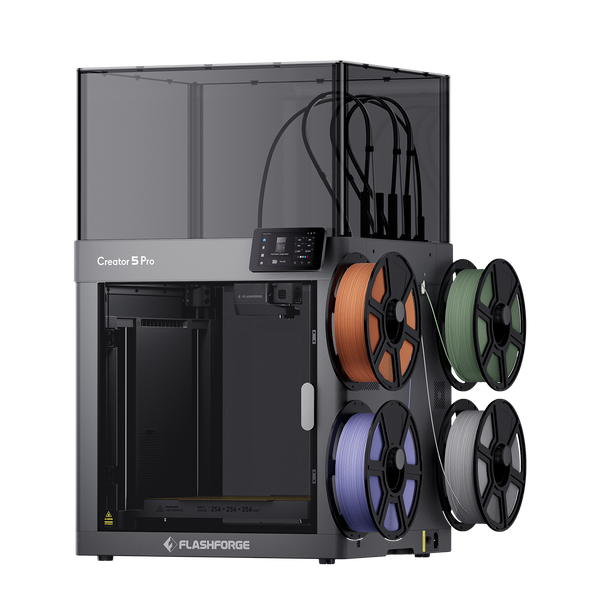
Flashforge Creator 5 Pro 4-Toolheads Enclosed Multi-Color 3D Printer | 500% Faster, Zero Purge Waste
This is especially useful for functional parts, engineering prototypes, and small batch printing where dimensional stability matters. A warmer, more stable chamber helps reduce warping, cracking, and uneven cooling during ABS printing.
Prioritize Ventilation and Filtration Features
ABS printing should be done with airflow and filtration in mind. The Flashforge Creator 5 Pro includes HEPA13 filtration plus activated carbon, which helps support a more controlled printing environment.
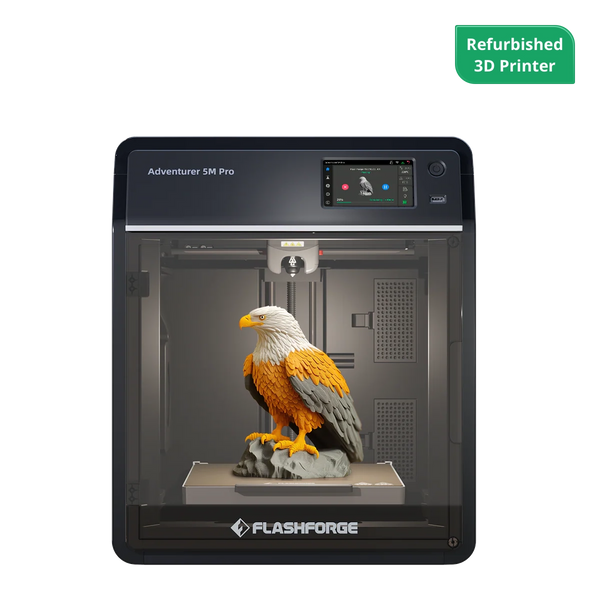
For smaller enclosed desktop workflows, the Flashforge Adventurer 5M Pro includes an enclosed CoreXY structure and HEPA plus activated carbon filtration. It is better suited to ABS or ASA than an open frame printer.
Check Bed Leveling and Print Monitoring
ABS prints often fail at the first layer, so automatic bed leveling is valuable. It helps keep the nozzle distance consistent across the build plate and reduces adhesion problems.
Print monitoring is also useful for long ABS jobs. A built-in camera makes it easier to check progress, identify early print issues, and manage longer functional parts without standing beside the printer the whole time.
Recommended Pick: Flashforge Creator 5 Pro
For users who plan to print ABS regularly, the Flashforge Creator 5 Pro is a practical fit because it combines an enclosed frame, active chamber heating up to 65°C, a 320°C maximum extruder temperature, a 120°C heated bed, automatic leveling, and HEPA13 plus activated carbon filtration.
This setup helps create a more controlled ABS printing environment while also supporting professional workflows for prototypes, housings, brackets, and small-batch functional parts.
If you only print ABS occasionally and your parts are small to medium-sized, the Flashforge Adventurer 5M Pro can be mentioned as an entry-level enclosed option. It has an enclosed CoreXY structure, supports ABS and ASA, and includes HEPA plus activated carbon filtration, making it better suited to ABS than an open-frame printer.
When ABS Filament Is Not the Best Choice
ABS is useful, but it is not the right material for every job. Choose it when the part needs its strengths, not just because it sounds more durable.
Food Contact Parts Need Extra Caution
Do not assume ABS filament is food safe. Food contact use depends on the exact material, additives, colorants, coatings, print process, and final use condition.
The FDA defines food contact substances as materials that come into contact with food, including food packaging, processing equipment, preparation surfaces, and cookware. For 3D printed parts, layer lines can also trap residue and make cleaning difficult. For food contact applications, use materials and coatings specifically verified for that purpose.
Poor Ventilation Makes ABS Printing Harder
ABS should not be printed in a small, poorly ventilated room without controls. Odor is one warning sign, but emissions are not always fully represented by smell.
Use an enclosed printer, filtration, and appropriate room ventilation. In schools, offices, studios, or print farms, follow workplace safety guidance and avoid placing ABS printers near occupied desks without controls.
Outdoor Parts May Need ASA Instead
ABS can work for some covered or indoor functional parts, but ASA is usually better for long-term outdoor exposure. ASA offers stronger UV stability, making it a better choice for outdoor brackets, covers, vents, and parts that need weather resistance.
Choose ASA when the part will face sunlight, rain, heat cycles, or long-term outdoor use.
PETG or PLA May Be Easier for Simple Prints
If the part does not need ABS toughness or heat resistance, PLA or PETG may be easier. PLA is best for quick models, classroom use, and decorative parts. PETG is a good middle ground for users who want better toughness than PLA without the same warping risk as ABS.
For many everyday prints, easier materials can save time and reduce failed prints.
Conclusion
ABS filament is a strong, heat-resistant 3D printing material for functional prototypes, housings, brackets, tool parts, and end-use components that need more toughness than PLA. Its main advantages are durability, impact resistance, heat resistance, and post-processing flexibility.
The key to printing ABS successfully is controlling heat. Use a heated bed, an enclosed chamber, low cooling, dry filament, strong bed adhesion, and proper ventilation. For frequent ABS printing, a controlled enclosed printer such as the Flashforge Creator 5 Pro is a stronger choice than an open frame machine.
FAQ
What are the downsides of ABS filament?
The main downsides of ABS filament are warping, lifting, layer splitting, odor, and higher hardware requirements. ABS usually needs a heated bed, enclosed chamber, low cooling, and good ventilation. It is more durable than PLA, but it is not as beginner-friendly.
Is ABS filament food safe?
ABS filament should not be treated as food-safe unless the exact filament, additives, coating, and final printed part are verified for food contact use. The FDA requires food contact substances to be suitable for their intended use, so printed ABS parts should be handled with caution for kitchen or food contact applications.
Why does ABS filament warp?
ABS filament warps because it shrinks as it cools. If the bottom layers cool faster than the upper layers, internal stress pulls the corners upward. A heated bed, enclosure, brim, stable chamber temperature, and better part design can reduce warping.
Does ABS filament smell when printing?
Yes, ABS often produces a noticeable smell when printing. Odor is one reason ABS should be printed with an enclosure, filtration, and proper ventilation. For a deeper setup guide, read Flashforge’s article on whether you need to vent ABS when 3D printing.
Can you mix PLA and ABS?
PLA and ABS are usually not mixed in the same print unless you have a controlled multi-material workflow. They print at different temperatures and do not bond reliably with each other. For most users, it is better to choose one material for the part or use a printer designed for multi-material printing.
Is PLA filament better than ABS?
PLA is better for beginners, decorative models, classroom prints, and quick prototypes because it is easier to print and has less warping. ABS is better for functional parts that need more toughness, heat resistance, impact resistance, and post-processing flexibility.