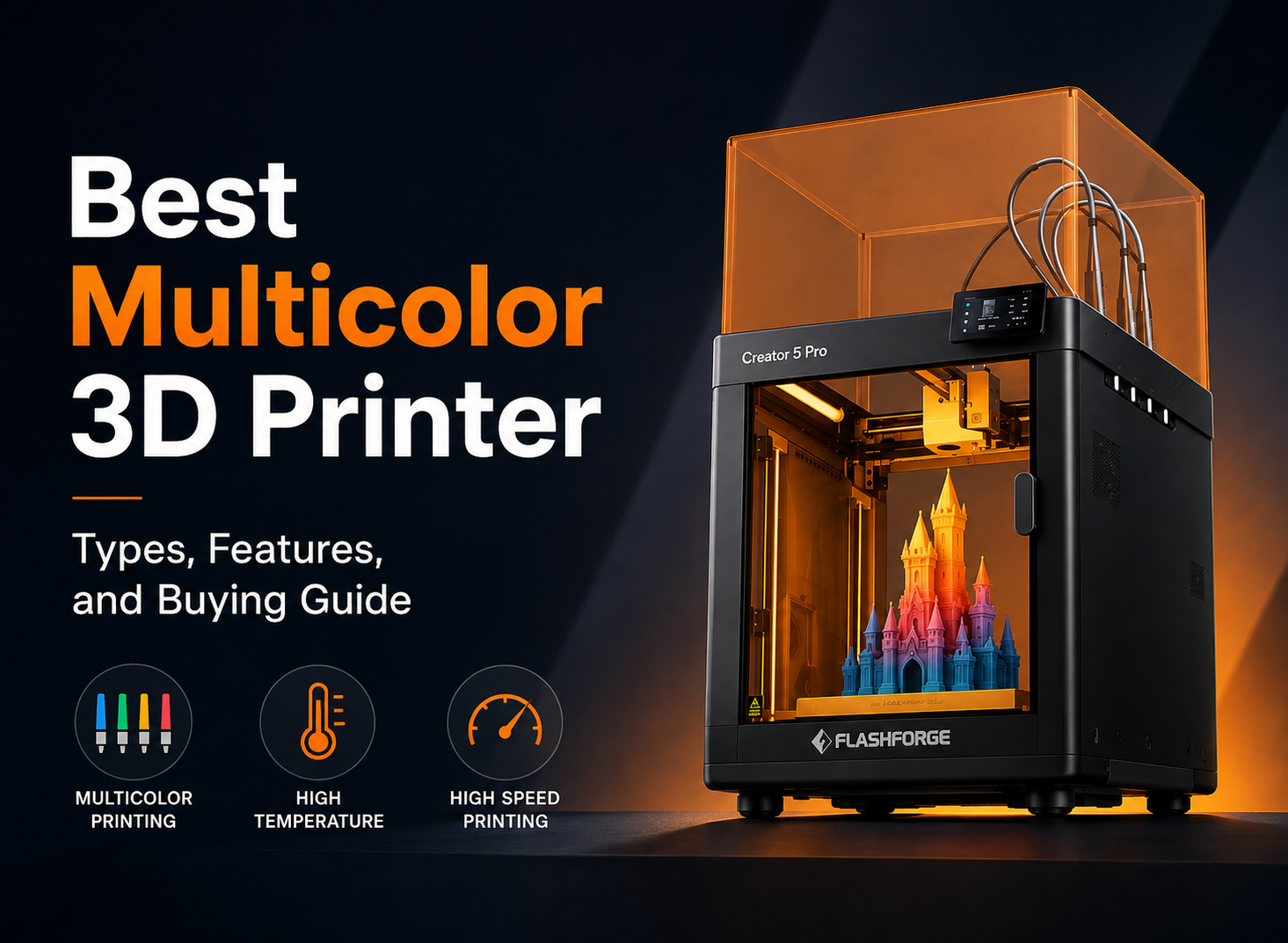



Large-format FDM 3D printers make it possible to produce oversized prototypes, functional parts, fixtures, props, and display models without dividing every design into multiple sections. Their larger build volume gives engineers, manufacturers, educators, and creators more freedom to test full-scale ideas, reduce assembly work, and produce short runs of customized parts.
However, a larger print area also brings new requirements for motion stability, material control, filament supply, bed adhesion, and long-print reliability. This guide explains how large-format FDM printing works, how it compares with resin, SLS, and MJF technologies, where it is commonly used, and which specifications matter when choosing a suitable printer.
What Is a Large-Format FDM 3D Printer?
A large-format FDM 3D printer is an FDM machine with a build volume large enough to print oversized models, tall prototypes, production aids, or full-scale parts that would be difficult on a standard desktop printer.
How Does a Large-Format FDM 3D Printer Work?
A large-format FDM printer works like other FDM machines: it melts thermoplastic filament in a heated nozzle and deposits the material layer by layer. The difference is scale. Larger printers need a more rigid frame, stable motion system, reliable bed heating, and consistent filament feeding because print jobs may run for many hours or even several days.
What Build Volume Is Considered Large Format?
There is no single universal cutoff, but a printer is often considered large format when its build area clearly exceeds common desktop sizes such as 220 × 220 × 220 mm or 256 × 256 × 256 mm. Build volume should be judged by the parts you actually print. A tall prototype, long fixture, or full-size display model may need more Z height or a wider bed than a normal hobby project.
Large-Format vs. Standard Desktop FDM 3D Printers
Standard desktop FDM printers are easier to place, easier to heat, and often better for small models, learning, and everyday parts. Large-format printers offer more freedom but require more planning. They use more filament, take longer to print, and make bed adhesion, warping control, and print recovery more important.
How Does Large-Format FDM Compare With Other 3D Printing Technologies?
Large-format FDM is only one additive manufacturing option. Resin, SLS, and MJF can be better for certain details or production workflows, but FDM remains practical when part size, material cost, and simple operation matter.

Large-Format FDM vs. Resin 3D Printing
Resin printing is strong for fine details, smooth surfaces, miniatures, and small visual parts. Large-format FDM is usually better for oversized models, functional prototypes, fixtures, and durable thermoplastic parts. Resin also requires liquid resin handling, washing, curing, and more careful workspace management, while FDM uses filament and usually has a simpler post-print workflow. Flashforge’s guide to different 3D printer types gives a broader comparison of common printing technologies.
Large-Format FDM vs. SLS and MJF Printing
SLS and MJF are powder-based industrial processes often used for strong, complex, and production-ready parts. They can print without traditional support structures because unsintered powder can help support geometry during printing. Large-format FDM is usually more accessible for in-house prototyping, education, and workshop use, but it often needs support planning for overhangs and may require more surface finishing.
When Is Large-Format FDM the Better Choice?
Large-format FDM is the better choice when you need large thermoplastic parts, fast design iteration, lower material cost, simple workshop operation, or full-scale fit testing. It is especially useful when the part does not require the fine surface detail of resin printing or the industrial powder-bed workflow of SLS or MJF.
What Are the Benefits of Large-Format FDM 3D Printing?
The main advantage of large-format FDM printing is not only size. Choosing the best 3d printer for these workflows also helps teams prototype, assemble, and test parts more efficiently.
Print Large Parts in One Piece
Printing a large part in one piece can save time and reduce assembly work. Instead of splitting a housing, prop, tool, or prototype into several sections, users can print a larger continuous model and preserve the original design shape more accurately.
Reduce Model Assembly and Post-Processing Work
When a model is split into sections, each joint needs alignment, bonding, sanding, filling, and finishing. Large-format printing can reduce these steps. This is useful for visual models, production aids, and prototypes where seams would affect appearance or fit.
Reduce Assembly-Related Weak Points and Dimensional Variation
Every joint can become a weak point or introduce slight dimensional error. Printing a larger section in one piece can improve consistency, especially for fixtures, covers, ducts, housings, and test-fit models. It does not automatically make the part stronger, but it removes some risks caused by manual assembly.
Create Full-Scale Prototypes for Real-World Testing
Full-scale prototypes help teams check ergonomics, clearance, installation space, and overall shape before committing to tooling or final manufacturing. This is valuable for product design, equipment development, automotive mockups, architecture, and education.
Expand Single-Print and Small-Batch Production Capabilities
Large-format FDM can also support short-run production. Workshops may print jigs, fixtures, molds, tooling aids, display parts, or replacement components in low quantities without investing in molds. For small batches, the ability to revise designs quickly can be more important than maximum throughput.
What Are Large-Format FDM 3D Printers Used For?
Large-format 3d printer systems are used wherever large plastic parts, full-scale models, and workshop-ready prototypes are needed.
Large Engineering Prototypes and Functional Parts
Large-format FDM 3D printers are often used for equipment housings, mechanical components, and near-real-size functional prototypes. These prints help design teams check appearance, assembly space, and part fit before formal production.
Jigs, Fixtures, and Small-Batch Production
Jigs and fixtures are common large-format FDM applications because they often need custom shapes, mounting points, or part-specific geometry. A large printer can produce assembly aids, drilling guides, inspection fixtures, and positioning tools in fewer pieces. This helps small manufacturers update production aids quickly without waiting for outsourced machining.
Cosplay Props, Sculptures, and Display Models
Creators use large-format FDM printers for helmets, armor, props, sculptures, signs, and exhibition displays. Larger build volume reduces the number of seams and makes finishing easier. For visual pieces, users may choose larger nozzles and thicker layers for draft printing, then sand, fill, paint, or coat the final part.
Education, Research, and Experimental Projects
Schools, universities, labs, and research teams use large-format FDM printing to test mechanisms, build models, visualize concepts, and create experimental tools. Large parts are especially useful for architecture, robotics, engineering, industrial design, and product development classes.
When Multi-Material Capability Matters More Than Maximum Build Volume
Large build volume is not the only consideration in professional FDM printing. Some projects fit within a desktop-sized workspace but require several materials, soluble supports, controlled chamber temperatures, or frequent design iterations. For these applications, a multi-toolhead engineering printer may provide more workflow value than a larger single- or dual-nozzle machine.
The Flashforge Creator 5 Pro combines four independent FlashSwap toolheads with a 256 × 256 × 256 mm build volume. Different model and support materials can remain installed on separate toolheads, reducing repeated filament changes and avoiding purge waste during material transitions. This makes the system well suited to complex prototypes, functional assemblies, jigs, fixtures, and small-batch engineering parts that fit within its build area.
Its fully enclosed frame, 65°C actively heated chamber, 320°C nozzles, and 120°C print bed provide controlled conditions for ABS, ASA, PA-CF, PET-CF, PAHT-CF, PPA-CF, PPS-CF, and soluble support materials such as PVA and BVOH. For professional users who prioritize multi-material flexibility, engineering-filament compatibility, and repeatable desktop production over maximum part size, Creator 5 Pro is a strong fit.
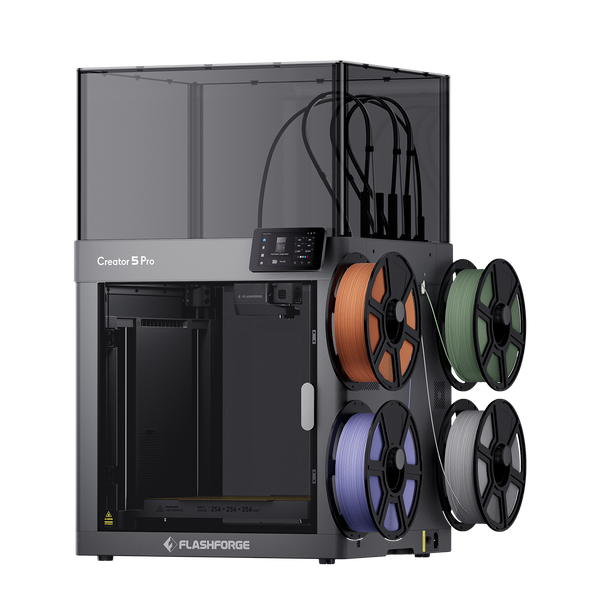
Flashforge Creator 5 Pro 4-Toolheads Enclosed Multi-Color 3D Printer | 500% Faster, Zero Purge Waste
How to Choose the Right Large-Format FDM 3D Printer
Choosing a large-format printer requires more than picking the biggest machine. The best option depends on model size, material, support requirements, print duration, and operating cost. Flashforge’s FDM printer buying guide is a helpful starting point when comparing build volume, speed, material support, and reliability.
Choose Build Volume Based on Actual Model Size
Start with the real dimensions of your typical models. A tall prototype needs Z height, while a flat fixture may need a wider XY area. Avoid choosing a printer only because it looks large on paper. Extra size is useful only when the frame, bed, and motion system can support reliable printing across the full area.
Choose an Open or Enclosed Design Based on Print Materials
Open printers can work well for PLA, PETG, and some basic workshop materials. Enclosed designs are better for materials that are sensitive to drafts, temperature changes, or warping. For large parts, material shrinkage becomes more noticeable, so enclosure and temperature control can matter more than on small prints.
Compare Print Speed, Flow Rate, and Motion Stability
Large parts can take a long time to print, so speed matters. However, maximum print speed is not the same as real-world print speed. Compare motion stability, acceleration, nozzle size, extrusion flow, cooling, and slicer profiles. A stable printer with consistent output is better than a fast printer that creates failed large prints.
Choose a Single or Dual Extruder Based on Material Requirements
A single extruder is enough for many large PLA, PETG, or simple functional parts. A dual-extruder printer becomes valuable when models require soluble support, breakaway support, mixed materials, or complex geometry. For large prints with internal channels, deep overhangs, or difficult support removal, dual extrusion can save significant finishing time.
Evaluate Long-Print Features and Operating Costs
Large-format printing requires long-print reliability. Look for filament runout detection, power-loss recovery, camera monitoring, automatic leveling, stable bed adhesion, and easy maintenance. Also estimate filament cost, nozzle wear, electricity use, support material, and failed-print risk before choosing a machine.
Tips for Successful Large-Format FDM Printing
Large-format FDM printing rewards preparation. A small slicer mistake can become expensive when the print uses hundreds of grams or several kilograms of filament.

Check the Model Before Slicing
Inspect the model for non-manifold edges, thin walls, floating shells, and impossible overhangs before slicing. A large print can fail late if the model has hidden geometry problems. Repairing the file first is faster than discovering an issue after many hours of printing.
Choose Nozzle Size and Layer Height Based on the Final Use
A 0.4 mm nozzle is versatile, but large prints often benefit from 0.6 mm or 0.8 mm nozzles. Larger nozzles can reduce print time and improve part strength, though they reduce fine detail. Choose layer height based on whether the part is a rough prototype, functional tool, or display model.
Plan Filament Supply Before Starting the Print
Large parts consume more filament than users expect. Check the slicer estimate, prepare enough filament, and avoid starting a print with a nearly empty spool. For moisture-sensitive materials, dry the filament before printing and keep it protected during long jobs.
Optimize Model Orientation and Support Placement
Orientation affects strength, surface quality, print time, support use, and warping risk. Place critical load paths in stronger directions, reduce unsupported overhangs, and avoid unnecessary support inside hard-to-reach areas. For visual parts, orient the model so visible surfaces need less finishing.
Test Critical Sections Before Printing the Full Model
Before printing a large final part, print a small section that includes the most important details, holes, joints, or support areas. This confirms fit, layer quality, strength, and material settings without wasting a full-size print.
Conclusion
A large-format FDM printer remains the appropriate choice when a project cannot fit within a standard desktop build volume. However, part size should not be evaluated in isolation. Material compatibility, support strategy, chamber control, calibration, and production efficiency may be equally important.
For parts that fit within a 256 × 256 × 256 mm workspace but require multiple materials, soluble supports, or engineering filaments, Flashforge Creator 5 Pro provides a professional alternative. Its four independent toolheads, actively heated chamber, automatic calibration, and enclosed workflow make it suitable for complex prototypes, functional parts, and selected small-batch production.
FAQ
Should You Request a Sample Print Before Buying a Large-Format FDM 3D Printer?
Yes, a sample print can help you judge surface quality, dimensional accuracy, layer consistency, and support removal. It is especially useful if you plan to print tall prototypes, fixtures, or production aids.
Does Open Firmware Matter on a Large-Format FDM Printer?
Open firmware can be useful for advanced users who want deep customization, but it is not required for every buyer. Many studios and schools prefer reliable preset profiles, manufacturer support, and stable software over advanced firmware control.
Should You Test the Full Build Area Before Printing a Final Part?
Yes. Large printers should be tested across the build plate, not only in the center. Print small calibration parts in different areas to check bed leveling, adhesion, dimensional consistency, and extrusion stability.
How Do You Prevent Warping on Large FDM Prints?
Use proper bed temperature, clean the build surface, choose the right material, add brim or raft when needed, control drafts, and use an enclosure for warp-prone materials. Large parts are more likely to warp because shrinkage forces build over a larger area.
How Much Surface Finishing Do Large FDM Parts Require?
Surface finishing depends on layer height, nozzle size, material, and final use. Rough prototypes may need little finishing, while props and display models may need sanding, filler, primer, paint, or coating to hide layer lines and seams.