


For functional parts exposed to repeated movement, impact, or friction, Nylon 3D printer filament is often a better fit than materials chosen mainly for easy printing. A gear inside a small machine, for instance, has to withstand far more wear than a decorative model sitting on a shelf. That durability comes from Nylon’s combination of toughness, wear resistance, and slight flexibility. Printing it takes more care, though, since moisture, temperature, and printer setup can all affect the result. This guide covers the main Nylon types, settings, applications, and storage practices.
What Is Nylon 3D Printer Filament?
Nylon is a popular engineering material in FDM 3D printing. Different formulations provide different performance advantages for specific applications.
What Is Nylon Filament Made Of?
The base material in Nylon filament is polyamide, usually abbreviated as PA. Its molecular structure gives the material a useful mix of toughness, wear resistance, and flexibility, which is why it appears in 3D printer filament intended for working parts rather than display-only models.
What Are the Common Types of Nylon Filament?
Different Nylon grades suit different printing needs:
- PA6 Nylon is strong and heat resistant, although its higher moisture absorption makes proper drying especially important.
- PA12 Nylon absorbs less moisture and holds dimensions more consistently, which helps with precision parts and fitted components.
- Nylon copolymers vary by formulation, with many designed to balance toughness, flexibility, and easier printing.
Standard vs Reinforced Nylon Filament
The choice between standard and reinforced Nylon depends on how the part will be used. Standard Nylon works well for clips, hinges, and snap-fit covers that need to bend slightly without cracking. For a rigid shelf bracket, drill guide, or workshop fixture that must stay stable under pressure, PA-CF or PA-GF may be more suitable. Their carbon or glass fibers reduce flexibility and improve rigidity, but they also wear down ordinary brass nozzles more quickly, so a wear-resistant nozzle is recommended.
Nylon vs PLA, PETG, ABS, and TPU
Nylon is often chosen for functional parts where toughness and durability matter more than easy printing. Compared with other popular FDM 3D printer filament options, it offers excellent mechanical performance but requires more attention to printing conditions.
| Material | Main Advantages | Common Uses |
| Nylon | Tough, wear-resistant, flexible | Gears, fixtures, functional parts |
| PLA | Easy to print, good surface quality | Models, prototypes, decorative parts |
| PETG | Balanced strength and easy processing | Everyday functional parts |
| ABS | Durable and heat resistant | Housings, mechanical components |
| TPU | Flexible and impact resistant | Seals, covers, flexible parts |
For a decorative model or desk ornament, PLA is usually the simpler choice. PETG also works well for items such as storage hooks, appliance brackets, or replacement handles that face moderate use. Nylon becomes more useful when the part moves or rubs against another surface every day, such as a gear in a small motor, a sliding door guide, or a workshop clamp that is tightened repeatedly. In these cases, resistance to wear and impact matters more than convenience during printing.
Key Properties of Nylon 3D Printing
Nylon is widely used for functional parts because of its strength, flexibility, and durability. These properties help parts withstand mechanical stress and repeated use.

High Toughness and Impact Resistance
Nylon handles sudden force well and is less likely to crack than a relatively brittle material such as PLA. That can make a noticeable difference in a protective tool housing that gets knocked off a workbench or a fastening clip that is pushed into place repeatedly. The part may bend or show minor surface damage, but it is more likely to remain usable after an impact.
Balanced Strength and Flexibility
Some parts need a little movement to work properly. A snap-fit battery cover, for example, must flex as it locks into place and then return close to its original shape. Nylon provides this balance of strength and controlled flexibility, making it suitable for clips, hinges, cable guides, and adjustable mounts that would be more likely to crack if printed in a rigid material.
Excellent Wear and Fatigue Resistance
A gear inside a small machine may rotate thousands of times, while a drawer guide or bushing is constantly rubbing against another surface. These parts do not usually fail from a single heavy load. Instead, repeated movement gradually wears them down. Nylon is well suited to such applications because it can maintain its function through many cycles of friction, bending, or rotation.
High Moisture Sensitivity During Printing
One drawback becomes clear when a Nylon spool is left on an open shelf, especially in a humid workshop. The filament absorbs moisture from the air, and that moisture turns to steam as it passes through the hotend. Popping sounds, bubbles, excess stringing, rough surfaces, and weak layer bonding may follow. Drying the spool before printing and keeping it sealed between jobs can prevent many of these problems.
What Are the Best Nylon Filament Settings?
Reliable Nylon printing depends on more than temperature. Printer capability, material preparation, and environmental control all affect print quality and layer bonding.
Printer and Nozzle Requirements for Nylon
A suitable printer setup is essential for successful Nylon printing. Understanding key 3D printer parts, especially the hotend and nozzle system, can also help users choose the right hardware. Nylon typically requires:
- A high-temperature hotend for reliable extrusion
- A heated bed for better layer adhesion
- A wear-resistant nozzle for reinforced Nylon such as PA-CF or PA-GF
For engineering-grade Nylon applications, printers with stronger thermal control, high-temperature hotends, and material compatibility can provide more consistent results, especially when printing large functional parts or reinforced Nylon materials.
Nozzle and Bed Temperature
Nylon usually prints hotter than PLA or PETG, but the correct nozzle and bed temperatures depend on the exact formulation. The filament manufacturer’s recommended range is therefore the best starting point.
If layers separate too easily, the nozzle may be too cool; heavy stringing or a messy surface can indicate excessive heat. A small test print can help confirm the settings before a longer job.
Enclosure and Chamber Temperature
Temperature stability becomes more important as Nylon parts get larger. A small clip may print successfully in a basic enclosure, while a wide mounting plate or machine housing is more likely to curl at the corners if the surrounding air cools unevenly. The hotend, heated bed, and chamber should therefore be considered together. For PA-CF or PA-GF, a wear-resistant nozzle is also necessary because the reinforcing fibers are abrasive. The enclosed Flashforge Creator 5 Pro adds active chamber heating up to 65°C, creating a more controlled environment for engineering Nylon and larger functional parts.
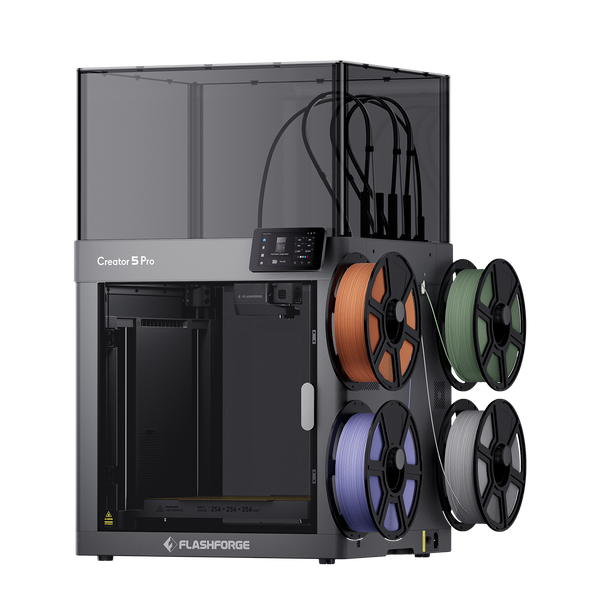
Flashforge Creator 5 Pro 4-Toolheads Enclosed Multi-Color 3D Printer | 500% Faster, Zero Purge Waste
Print Speed and Cooling Settings
PLA settings are not always a suitable starting point for Nylon. A decorative PLA model may print quickly with strong fan cooling, but the same approach can leave a Nylon gear or load-bearing bracket with poor layer adhesion or warped edges. Begin with a moderate speed and limited cooling, then adjust gradually after checking the first layers and surface quality. Small details may need some airflow, whereas larger functional sections often print better with little or no fan cooling.
Retraction and Flow Settings
Retraction and flow settings often need some adjustment when switching to Nylon. Moisture level, filament formulation, and printer setup can all change how the material extrudes.
Before committing to a large functional part, a small test can reveal stringing, over-extrusion, or uneven flow without wasting much filament.
What Are the Best Uses for Nylon Filament?
Nylon is a strong choice for functional parts that require toughness, wear resistance, and long-term durability. Its combination of mechanical performance and flexibility makes it suitable for components used in engineering, workshops, and product development.

Gears, Bushings, and Moving Parts
Nylon is a practical option for parts that move repeatedly and gradually wear against other surfaces. A gear may mesh thousands of times, while a bushing stays in regular contact with a moving shaft.
That combination of friction and repeated cycles is why Nylon is commonly used for gears, bushings, spacers, and similar functional parts.
Hinges, Clips, and Snap-Fit Parts
Snap-fit parts, clips, and hinges often need a material that can flex without cracking. Nylon handles this type of repeated movement well because it combines toughness with controlled flexibility.
A removable equipment cover, for instance, may be snapped on and off many times during maintenance without failing at the clip.
Jigs, Fixtures, and Workshop Tools
Custom jigs, fixtures, and workshop tools are common Nylon applications because the material provides both strength and impact resistance. These printed parts can assist with positioning, assembly, and repeatable tasks, while the right 3d printer can help produce reliable functional components with consistent quality.
Functional Prototypes and End-Use Parts
Functional prototypes, jigs, fixtures, and end-use parts often require materials with high strength, wear resistance, and long-term durability, which is why Nylon is widely used for these applications. However, achieving consistent results depends not only on the filament itself but also on printer stability and workflow efficiency. Flashforge Creator 5 Pro features a 256 × 256 × 256 mm build volume, four independent toolheads, and automatic toolhead calibration, helping users complete functional prototype validation, complex part printing, and small-batch production more efficiently.
Tips for Storing and Printing Nylon Filament
Reliable Nylon printing starts with proper storage and preparation. Because moisture can affect extrusion quality and part strength, keeping filament dry is essential for consistent results.
Store Nylon Filament in a Dry, Airtight Environment
Nylon should be stored in a sealed, dry environment because an exposed spool can absorb moisture even when it is not being used. An airtight container with desiccant helps reduce bubbling, stringing, and weaker layer bonding when the filament returns to the printer.
Dry Nylon Before Printing
A Nylon spool that has been exposed to open air for some time may need drying before printing. Moisture inside the filament can turn to steam in the hotend, resulting in popping sounds, rough extrusion, poor layer bonding, or excess stringing.
Use the drying temperature and time recommended for the specific filament rather than assuming every Nylon grade needs the same treatment.
Test New Nylon Before Starting a Long Print
A small test print is worth doing before a new Nylon spool goes into a long job. It can quickly show whether the temperature, extrusion, and filament condition are suitable before several hours of printing are committed to a functional part.
Keep Nylon Dry During Long Prints
Long Nylon prints can still absorb moisture while the spool is feeding, particularly in humid rooms. Printing directly from a dry box or enclosed storage system helps keep extrusion more consistent from the first layer to the last.
Conclusion
Nylon 3D printer filament is most useful when durability, wear resistance, and repeated mechanical use matter more than easy printing. Gears, fixtures, clips, and functional prototypes are typical examples.
PLA or PETG may remain more convenient for simpler projects, but with suitable hardware, correct settings, and good moisture control, Nylon is a reliable choice for demanding functional parts.
FAQ
Can a 3D Printer Use Nylon Filament?
Yes, provided the printer can reach the filament’s required nozzle and bed temperatures. Stable extrusion is also important, while abrasive grades such as PA-CF or PA-GF need a wear-resistant nozzle.
Is Nylon Hard to 3D Print?
Nylon is harder to print than PLA or PETG, mainly because it absorbs moisture and reacts strongly to temperature changes. Dry filament, suitable temperatures, and careful first-layer calibration make the process much more manageable.
Is Nylon Stronger Than PETG?
For impact, repeated movement, and wear, Nylon generally performs better than PETG. PETG remains easier to print, however, and is often sufficient for storage hooks, simple brackets, and other household parts.
Does Nylon Need a Heated Chamber?
Not always. Small Nylon parts may print successfully without active chamber heating. Larger components and engineering-grade formulations benefit more because a controlled chamber reduces uneven cooling, warping, and layer separation.
What Are the Disadvantages of Nylon Filament?
Nylon absorbs moisture quickly, requires higher printing temperatures, and can be difficult to keep dimensionally stable. Reinforced grades also wear standard brass nozzles, adding another hardware consideration.
Does Nylon Filament Need an Enclosure?
An enclosure is not essential for every Nylon print, but it becomes increasingly useful as part size grows. By limiting drafts and temperature swings, it helps wide or tall models retain their shape during printing.