


3D printing is increasingly used for vehicle customization, prototypes, replacement pieces, and small repair projects. It can be a practical solution for interior trim, organizers, clips, covers, mounts, and test-fit models.
However, not every vehicle part is suitable for 3D printing. Heat, vibration, sunlight, chemicals, and repeated stress can cause failures if the wrong material or design is used. This guide covers what vehicle parts you can print, the best materials to choose, and the key limits to consider before starting a project.
What Vehicle Parts Can You 3D Print?
3D printing works best for low-risk vehicle parts, custom accessories, replacement trim, and prototypes. These parts usually do not carry major load, control safety systems, or sit in high-temperature zones.
Interior Trim and Cosmetic Parts
Interior trim is one of the most practical areas for 3D printing vehicle parts. Small trim caps, dashboard blanks, switch surrounds, vent accents, console inserts, and decorative covers can often be printed when the original part is broken or no longer available.
For interior parts, the main requirements are fit, surface finish, heat resistance, and color matching. PLA can work for quick test fits, but it may soften in hot cabins. PETG, ABS, or ASA are often better for parts that stay inside a vehicle for longer periods.
Organizers, Mounts, and Custom Accessories
3D printing is useful for custom vehicle accessories. Phone mounts, cable clips, cup holder inserts, camera mounts, tool organizers, camper storage brackets, and trunk dividers can be designed around your exact layout.
These parts should be designed with vibration and repeated use in mind. A phone mount, for example, should not block visibility, interfere with airbags, or become a loose object during sudden braking. Good design matters as much as material choice.
Replacement Clips, Covers, and Small Non-Load Parts
Small clips, caps, plugs, covers, and plastic retainers are common 3D printing projects. These parts are often hard to buy individually, especially for older vehicles.
The safest approach is to copy the original shape carefully, print a test version, and check fit before using the part long term. If the part holds trim in place, covers a small opening, or replaces a cosmetic cap, 3D printing can be practical. If the part holds a safety system, supports load, or affects steering, braking, suspension, or restraint systems, do not treat a DIY print as a direct replacement.
Prototype Parts for Testing Fit and Shape
For large prototype pieces, users may need to split the model or use a printer with more build volume. Flashforge Guider 3 Ultra is a natural fit for this type of work because it offers a 330 × 330 × 600 mm build volume in single-extruder mode, dual-extruder printing, and soluble-support workflows for tall models, prototypes, and complex functional parts.
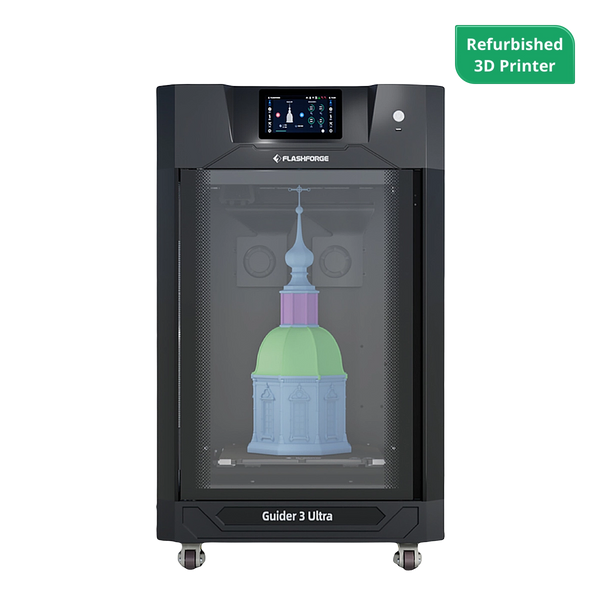
Imprimante 3D Flashforge Guider 3 Ultra à double extrudeuse, structure Core-XY avec grand volume de fabrication de 330 x 330 x 600 mm
Best Materials for 3D Printing Vehicle Parts
Material choice is one of the most important decisions when 3D printing vehicle parts. The best material depends on temperature, load, sunlight, vibration, and whether the part is temporary or long term. Flashforge’s 3D printer filament guide is a useful reference when comparing common materials such as PLA, PETG, ABS, ASA, nylon, TPU, and support materials.
PLA for Test Fits and Temporary Prototypes
PLA is easy to print, affordable, and useful for early test fits in FDM 3D printing. It is a good choice when you need to check size, shape, screw alignment, or panel clearance before printing the final part.
PLA is not ideal for long-term car use. Vehicle interiors can become very hot, and NHTSA notes that the inside temperature of a car can rise quickly, including nearly 20°F within the first 10 minutes in some conditions. That kind of environment can soften or deform low-heat materials. Use PLA for prototypes, not for parts exposed to heat or stress.
PETG for Everyday Interior Parts
PETG is a practical material for many everyday interior parts. It is tougher than PLA, has better heat resistance, and can handle light flex better. PETG can be suitable for organizers, clips, small covers, cable guides, and some low-load brackets inside the cabin.
It is still not a universal vehicle material. PETG may struggle in very hot locations, direct sunlight, or parts under constant mechanical stress. Use it when the part is inside the cabin, away from major heat sources, and not safety critical.
ABS and ASA for Heat and Outdoor Exposure
ABS and ASA are better choices when heat resistance matters. ABS is often used for functional prototypes and parts that need more impact resistance than PLA. ASA is commonly chosen for outdoor exposure because it handles UV and weather better than many basic materials.
For exterior or sun-exposed parts, ASA is usually a stronger choice than PLA or PETG. For interior parts that may face cabin heat, ABS or ASA can be more reliable if printed correctly. These materials often need an enclosed printer, good bed adhesion, and temperature control to reduce warping.
Flashforge’s guide on how to use a 3D printer for different filaments is helpful when matching filament type with printer setup, bed temperature, adhesion, and slicer settings.
Nylon, Carbon Fiber, and TPU for Special Uses
For users working with demanding materials, Flashforge Creator 5 Pro supports materials such as ABS, ASA, PA-CF, PAHT-CF, PC, PA, PC-ABS, and PPS-CF. Its hardened steel nozzles, fully enclosed structure, active chamber heating up to 65°C, and controlled airflow help with engineering prints that need more stable conditions.
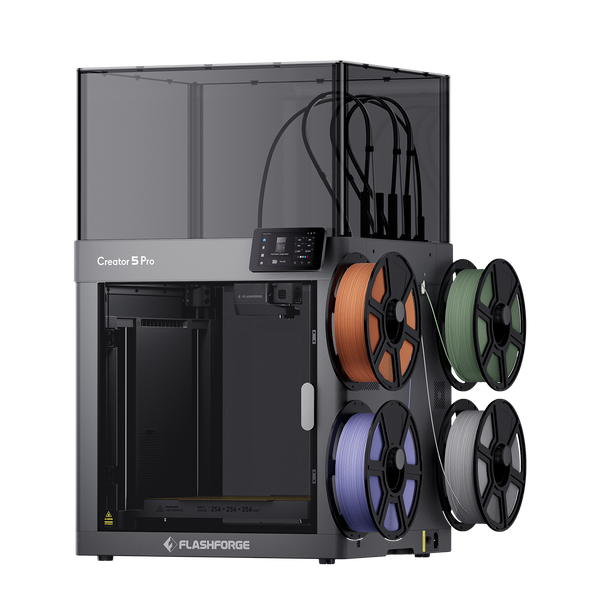
Flashforge Creator 5 Pro 4-Toolheads Enclosed Multi-Color 3D Printer | 500% Faster, Zero Purge Waste
Key Requirements for Printing Vehicle Parts
Vehicle parts face a tougher environment than many household prints. Before choosing a model, material, or slicer setting, think about where the part will be installed and what it must survive.
Heat Resistance Matters Inside a Car
A parked vehicle can become much hotter than the outside air. Dashboard areas, windshield-adjacent panels, and closed cabins can expose parts to heat that may soften weak materials.
This is why PLA should be limited to test fits or temporary use. For cabin parts, PETG may be acceptable in lower-risk locations, while ABS or ASA is a better choice for higher heat exposure. For engine bay or near-engine areas, even stronger materials may not be enough unless the design is validated carefully.
Strength Depends on Design, Not Just Filament
Choosing stronger 3d printer filament does not automatically make a vehicle part durable. Layer orientation, wall thickness, infill, mounting points, screw holes, and part geometry all affect its overall strength.
For brackets and clips, avoid sharp internal corners because they concentrate stress. Add fillets, increase wall thickness around holes, and print the part so layer lines do not split under load. If a part will be pulled, twisted, or vibrated repeatedly, test it before relying on it.
UV and Weather Resistance for Exterior Parts
Exterior parts face sunlight, rain, dirt, temperature swings, and road vibration. PLA and many basic filaments can degrade or deform outdoors. ASA is often a better choice for exterior cosmetic parts because it is designed for better UV and weather resistance.
For exterior parts, also think about water paths and mounting security. A loose printed part can become a hazard if it falls off while driving.
Dimensional Accuracy for Fit and Assembly
Vehicle parts often need a tight fit. A clip that is too thick may not snap in. A mount that is slightly misaligned may rattle. A cover that is too loose may fall out.
Print a test piece before making the final version. For holes, slots, and clips, allow for printer tolerance and material shrinkage. ABS, ASA, nylon, and PC can shrink more than PLA, so calibration matters.
Printer Setup Must Match the Material
The printer must match the material. PLA and PETG are easier to print on many desktop machines. ABS, ASA, PA, PC, and fiber-reinforced filaments usually need stronger temperature control, proper drying, stable bed adhesion, and suitable nozzles.
For engineering materials, an enclosed printer with chamber control is often more reliable than an open-frame setup. This is especially important for larger parts, where warping and layer splitting become more likely.
Limits of 3D Printing Vehicle Parts
The limits of 3D printing vehicle parts are not only about what can or cannot be printed. The real question is whether a printed part can handle heat, force, chemicals, weather, and legal responsibility in its actual location.
Not Every Part Can Handle Heat, Load, and Vibration
Many vehicle parts experience repeated vibration, impact, and thermal cycling. A print that feels strong by hand may crack after months of driving.
Use 3D printed parts for low-risk applications first. For load-bearing or long-term parts, test the material, print orientation, mounting method, and heat exposure. Avoid assuming that a printed part is equivalent to injection-molded or factory-tested plastic.
Safety-Critical Parts Are Not Suitable for DIY Printing
Do not DIY print parts related to braking, steering, suspension, airbags, seat belts, child restraints, crash structures, or other safety systems. NHTSA issues Federal Motor Vehicle Safety Standards for vehicles and motor vehicle equipment, and it also addresses safety defects and recalls for regulated equipment.
A printed cosmetic cover is very different from a part that affects how a vehicle protects people in a crash. When safety is involved, use certified replacement parts and professional repair guidance.
Engine Bay Parts Have Higher Failure Risks
Engine bay parts face heat, vibration, oil, fuel vapor, water, and chemical exposure. This environment is difficult for many 3D-printed plastics.
Even high-temperature materials can fail if they are printed with poor layer bonding, exposed to fluids, mounted near heat sources, or loaded in the wrong direction. For engine bay use, 3D printing is better for mockups, temporary test pieces, or carefully validated non-critical parts.
Automotive Fluids Can Damage Printed Materials
Before using a printed part near fluids, check chemical compatibility and test a sample. Do not use an untested printed part to seal, carry, or control automotive fluids.
Legal, Inspection, and Insurance Issues Matter
Laws and inspection rules vary by country, state, and use case. A part used on a private show car may be treated differently from a part used on a road vehicle, commercial fleet, or safety-related system.
If a printed part changes lighting, visibility, crash protection, occupant safety, or vehicle operation, check local rules before using it. Insurance and inspection concerns may also apply if a modified part fails or contributes to damage.
Conclusion
3D printing is a practical option for vehicle customization, prototypes, and low-risk parts such as trim, clips, mounts, covers, and organizers.
Choose materials based on the application: PLA works for prototypes, PETG for many interior parts, and ABS/ASA for higher heat or outdoor exposure. Nylon, TPU, and reinforced filaments are better for specialized projects.
However, 3D printing is not a replacement for safety-critical components. Heat, vibration, chemicals, load, and regulations must always be considered. For suitable applications, it can be an effective way to customize and repair vehicle parts.
FAQ
How Much Does It Cost to 3D Print Car Parts?
The cost depends on material, size, infill, print time, support material, failed prints, and post-processing. A small PLA test-fit part may cost only a few dollars in material, while a larger ABS, ASA, nylon, or carbon-fiber-reinforced part can cost much more because the material is more expensive and the print may take longer.
How Long Does It Take to 3D Print a Car Part?
Small clips or caps may print in less than an hour. Interior organizers, covers, or mounts may take several hours. Large prototype pieces can take a full day or more, especially if they need supports, high infill, or slow print settings for stronger materials.
Is It Illegal to 3D Print Car Parts?
3D printing car parts is not automatically illegal, but the use case matters. Low-risk custom accessories and cosmetic parts are usually very different from safety-related or road-regulated components. Check local laws, inspection rules, and insurance requirements before using printed parts on a road vehicle.
Can I 3D Print a Bumper?
You can 3D print bumper-related prototypes, trim pieces, covers, or scale models, but a road-use bumper is a safety-related vehicle component. A DIY printed bumper should not be treated as a certified crash structure. For real vehicle repair, use approved replacement parts and professional guidance.