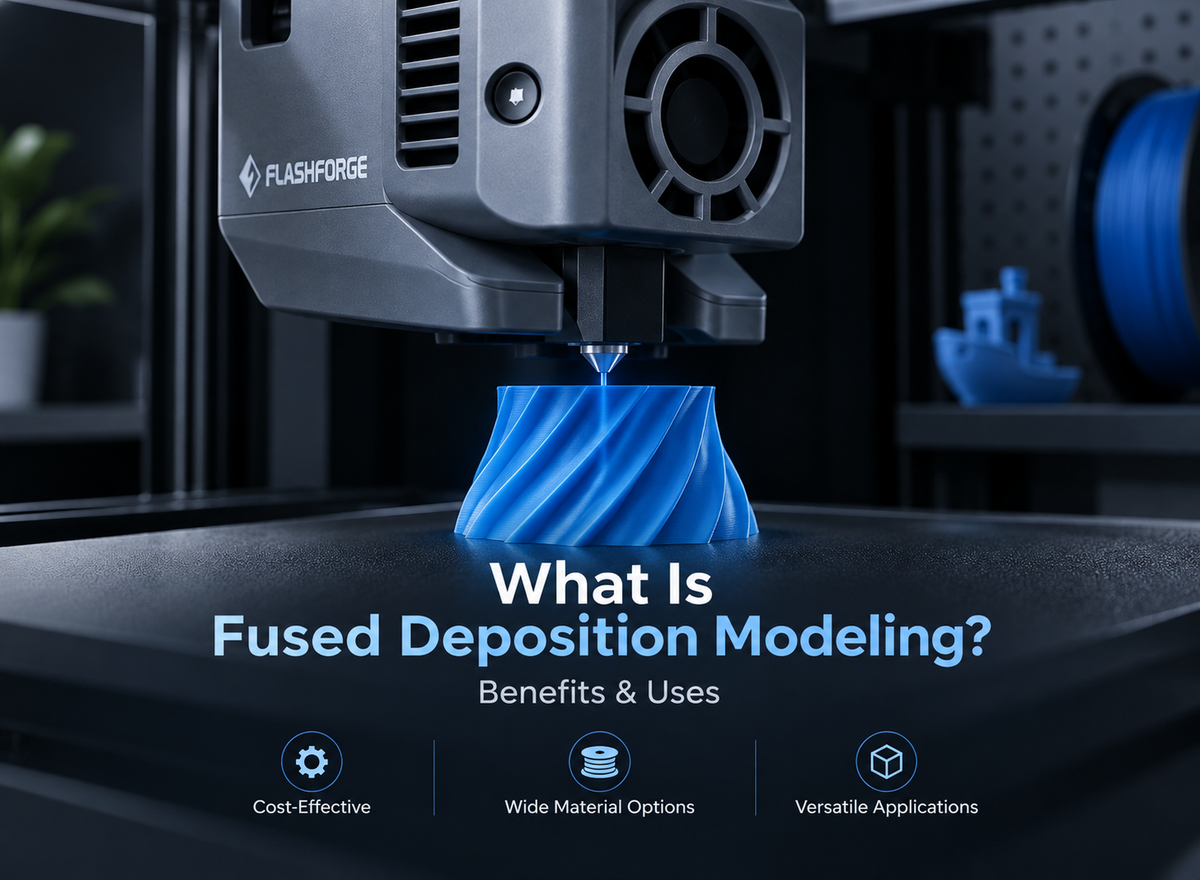



3D printing makes it easier to create vases, organizers, wall accents, planters, and decorative objects for a particular room. A suitable 3D printer for home decor, however, must do more than produce attractive models. Noise, ventilation, hot components, and setup difficulty all affect how comfortably it fits into home life.
This guide explains what to look for when choosing a printer for 3D printing for home decor, compares three Flashforge models for different creative needs, and covers practical ways to print more quietly and safely at home.
How Much Do Noise and Safety Matter at Home?
A printer used in a workshop may be separated from living areas, but a desktop 3D printer at home often shares space with work, study, and family activities. Noise and safety features therefore affect when, where, and how comfortably the printer can be used.

Low Noise Improves the Home Printing Experience
Tall vases, lampshades, and organizer sets may run for hours, so fan and motor noise can become distracting. Decibel figures help with comparison but do not describe vibration or fan tone. A rigid table and suitable vibration-isolating mat can reduce rattling, provided that airflow remains unobstructed.
Safety Reduces Risks During Home 3D Printing
FDM printers contain a hot nozzle, heated bed, and moving components. Printing can also release ultrafine particles and volatile organic compounds, depending on the material and conditions. NIOSH guidance identifies ventilation as an important control and discusses enclosures and HEPA filtration. Keep children and pets away, follow the manual, and operate the machine on a stable surface with clear vents.
Key Features for Safe and Quiet Home 3D Printing
No single feature makes a printer ideal for every home. The best setup combines physical protection, stable motion, sensible monitoring, and an installation location suited to the 3D printer filament being used.
Enclosed Design for Added Safety
An enclosed 3D printer creates a barrier around the nozzle, bed, and printhead. It can also reduce drafts and contain some noise. Open printers need a controlled location away from table edges, walkways, curtains, children, and pets. An enclosure does not replace supervision or ventilation.
Automatic Safety and Monitoring Features
Filament detection and power-loss recovery can save a long print. Automatic leveling reduces setup, while a camera allows remote progress checks. Monitoring is useful but is not fire detection or permission to ignore the manufacturer’s operating instructions.
Stable Build for Reduced Vibration
A rigid frame and stable motion system support cleaner surfaces during 3D printing while limiting vibration transferred to furniture. Even a well-built printer can sound louder on a hollow or uneven cabinet.
Low-Noise Motors and Cooling Fans
Motor control and fan design both affect sound. A low-noise mode helps near living spaces, although slower operation may extend print time. Compare the manufacturer’s stated modes rather than assuming every enclosed printer is quiet.
Best 3D Printers for Home Decor in 2026
The best 3D printers for home decor depend on whether the priority is an enclosed home setup, accessible multicolor printing, or a more advanced multi-material workflow. The following models serve different types of home creators rather than representing a simple ranking from basic to best.
Best for Safer Enclosed Home Printing: Adventurer 5M Pro
The Flashforge Adventurer 5M Pro uses a fully enclosed structure and combines internal and external air circulation with HEPA and activated-carbon filtration. Flashforge lists a 50 dB low-noise mode and a 55 dB standard mode.
Automatic leveling, a camera, filament detection, and a 220 × 220 × 220 mm build volume make it practical for organizers, planters, and display pieces. The room should still have appropriate ventilation for the selected filament.
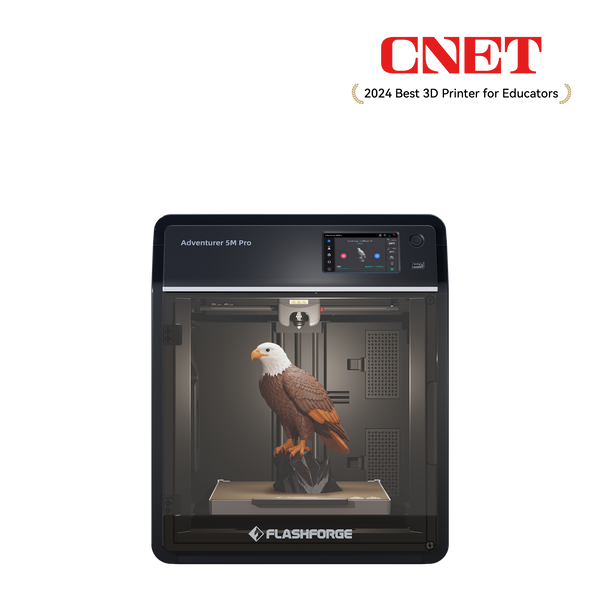
Imprimante 3D Flashforge Adventurer 5M Pro, structure métallique CoXY fermée, sans danger pour un usage domestique
Best for Easy Multi-Color Home Decor Printing: AD5X
Colorful nameplates, holiday decorations, and personalized ornaments often require painting when produced on a single-color printer. The Flashforge AD5X uses one extruder with an integrated Intelligent Filament System to automate filament handling and support four-color printing. This makes color part of the digital workflow instead of a separate finishing step.
It also provides automatic leveling, a 220 × 220 × 220 mm build volume, and support for PLA, PETG, selected TPU grades, PLA-CF, and PETG-CF. Its open frame and lack of built-in filtration require more careful placement and ventilation.
Best for Advanced Multi-Color and Multi-Material Home Decor: Creator 5
More ambitious decor may combine several colors, soluble support, or rigid and flexible sections. The Flashforge Creator 5 uses four independent toolheads, each assigned its own filament, enabling automatic changes with less repeated purging than a shared-nozzle workflow.
Its 256 × 256 × 256 mm build volume accommodates layered wall art and multi-material objects. As an open-frame machine, it makes more sense in a dedicated hobby room than an easily accessed family space.
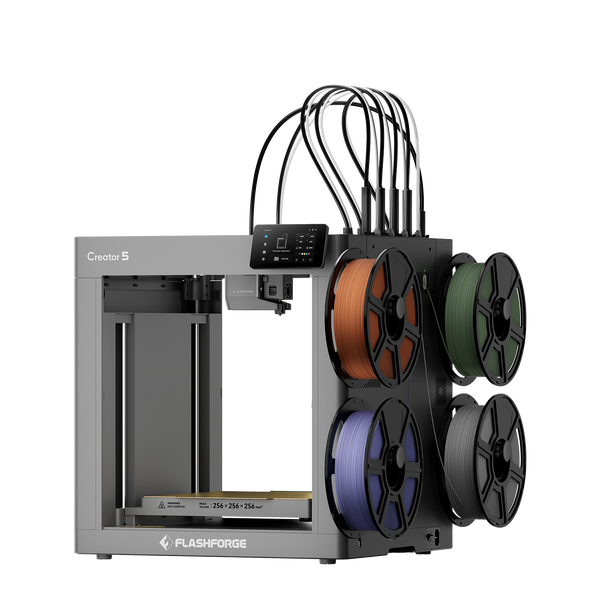
Flashforge Creator 5 4-Toolheads Multi-Color 3D Printer | 500% Faster, Zero Purge Waste
Quick Comparison of Price, Materials, and Enclosure
Prices change with region and promotion, so the table uses relative price levels rather than temporary sale prices.
| Model | Price level | Relevant material support | Enclosure | Best for |
|---|---|---|---|---|
| Adventurer 5M Pro | Mid-range | PLA, PETG, ABS, ASA; selected TPU, PLA-CF, and PETG-CF with compatible nozzles | Enclosed | Quieter, more controlled home printing |
| AD5X | Entry to mid-range | PLA, PETG, selected TPU, PLA-CF, PETG-CF | Open | Accessible four-color decor |
| Creator 5 | Advanced | PLA, PETG, TPU, PLA-CF, PETG-CF, PVA, BVOH, and other listed materials | Open | Advanced multi-color and multi-material decor |
How to Print Home Decor More Safely and Quietly
Even the best home 3D printer is only one part of a comfortable setup. Placement, ventilation, access control, and print settings can have just as much influence on everyday comfort.
Place the Printer on a Stable Surface
Use a level, rigid surface that will not wobble. Leave the manufacturer’s recommended clearance around vents, cables, and moving parts, and keep tall prints away from doors and walkways.
Keep the Printing Area Well Ventilated
Print in a ventilated room and follow the filament manufacturer’s guidance. Enclosures and filters can help, but filters require maintenance and do not replace fresh air. Avoid bedrooms and poorly ventilated closets.
Keep Hot and Moving Parts Out of Reach
Do not reach inside a moving printer. Let the nozzle, bed, and part cool before handling them, keep children and pets away, and stop using equipment with damaged cords or connectors.
Use Lower Speeds for Quieter Printing
Reducing speed and acceleration may lower motion noise and vibration, although results vary. Start from a tested profile, make small changes, and confirm that cooling and extrusion remain adequate.
Other Tips for Better Home Decor Prints
Good decor depends on material, surface settings, and model preparation as much as it does on printer choice. These decisions should be made before a long print begins.
Choose the Right Filament for Each Project
PLA is a practical choice for indoor vases, ornaments, and low-stress organizers. PETG is often preferable where greater toughness or moisture resistance is needed. The Flashforge guide to PLA vs. PETG explains how printability, strength, heat, and moisture resistance affect the choice.
For outdoor decor, consider a weather- and UV-resistant material such as ASA with suitable printing conditions. Match the material to actual temperature, load, and exposure.

Adjust Layer Height for Better Surface Quality
Smaller layers make curves appear smoother but increase print time. Larger layers suit broad planters or textured organizers. Variable layer height can preserve visible detail without slowing the whole model.
Use Supports Carefully for Decorative Models
Supports can mark decorative surfaces. Change the orientation, use support-friendly angles, or split the object before printing. Anyone creating original 3D printing designs for home decor can reduce finishing by considering overhangs, walls, and assembly during modeling. The guide to creating 3D models for printing explains the broader preparation workflow.
This planning also expands the range of practical 3D printing ideas for home decor, from modular wall tiles and custom drawer inserts to planters sized for a particular shelf.
Conclusion
Successful 3D printing for home décor depends on more than appearance. An enclosed printer such as the Adventurer 5M Pro is the strongest fit here for households prioritizing controlled access, filtration, and a documented low-noise mode. The AD5X offers an easier route into four-color decor, while the Creator 5 serves advanced users who want independent toolheads and more complex material combinations.
Pair any model with a stable surface, ventilation, controlled access, and a material suited to the finished object’s location.
FAQ
Is FDM or Resin Better for Home Decor?
FDM is easier to manage for many vases, organizers, and functional pieces. Resin can produce finer detail and smoother small models, but uncured resin requires protective equipment, careful handling, washing, post-curing, and ventilation. Choose according to size, detail, material needs, and the workflow your home can support safely.
Are 3D Printed Planters Waterproof?
Not automatically. Gaps and seams may leak. More walls, good layer bonding, and a compatible coating can improve resistance, while an inner pot or liner is often the simplest way to protect furniture.
Can 3D Printed Home Decor Be Used Outdoors?
Yes, if the material matches the exposure. PLA can soften in heat and degrade outdoors. PETG offers better moisture and moderate heat resistance, while ASA is usually stronger for prolonged UV and weather exposure. Also consider drainage, wall thickness, wind, and seasonal temperature.
Are 3D Printed Lampshades Safe to Use?
Do not assume a printed lampshade is fire-safe. Use listed electrical components, a low-heat LED bulb within the fixture’s rating, ventilation, and clearance; never let plastic touch the bulb or heat-producing hardware. UL’s plastics combustion-testing overview shows why material performance must be evaluated. A decorative print is not a certified luminaire unless the complete assembly has been assessed.
How Durable Is 3D Printed Home Decor?
Durability depends on filament, walls, layer bonding, orientation, and environment. PLA suits many indoor displays, while PETG or ASA may be better for moisture, impact, or outdoor exposure. Design around the loads the object will experience.