



Fused deposition modeling (FDM) is one of the most widely used forms of desktop 3D printing. Fused deposition modeling 3D printing creates parts by heating thermoplastic filament, depositing it along a programmed path, and building the object one layer at a time. The process is accessible and flexible enough for everything from classroom models to engineering fixtures.
FDM is not the best choice for every part, however. Visible layer lines, direction-dependent strength, support marks, and material shrinkage can affect the result. Understanding these tradeoffs helps you decide when FDM 3D printing is the right method.
What Is Fused Deposition Modeling?
Fused deposition modeling is an additive manufacturing process that builds directly from a digital model. Under the terminology established in ISO/ASTM 52900, it belongs to the material extrusion category.
What Does FDM Stand For?
FDM stands for fused deposition modeling. The term is often used interchangeably with fused filament fabrication, or FFF, when discussing desktop 3D printer technology. Both normally describe the same basic workflow: a thermoplastic filament is softened, extruded through a nozzle, and deposited in successive layers.
“Material extrusion” is the broader process category, while FDM and FFF commonly refer to filament-based thermoplastic printing.
How Does Fused Deposition Modeling Work?
The process begins with a 3D model, usually exported in a format such as STL or 3MF. Slicing software divides the model into horizontal layers and generates the toolpaths that control nozzle movement, extrusion, speed, temperature, infill, and supports.
The printer then follows a repeating sequence:
- Drive gears feed filament from the spool toward the hot end.
- The hot end softens the material and pushes it through the nozzle.
- The nozzle deposits roads of material to form the first layer.
- The printhead or build platform moves along the Z-axis.
- New material bonds to the layer below until the part is complete.
The quality of those bonds matters. NIST research on thermoplastic extrusion 3D printing explains that the strength of an FFF part is limited in part by the welds between layers, which are affected by thermal conditions during deposition.

Key Characteristics of FDM Printing
An FDM 3D printer uses solid filament, produces controllable internal structures, and requires relatively little cleanup. Users can adjust wall count, infill, layer height, and orientation to balance speed, finish, weight, and strength. Nozzle temperature, cooling, moisture, and geometry also influence final performance.
What Materials Does FDM Use?
Most desktop FDM printers use 1.75 mm 3D printer filament, but material behavior varies widely. Always confirm the printer’s maximum nozzle and bed temperatures, enclosure requirements, nozzle material, and approved filament types before printing.

PLA and PETG
PLA is easy to print, has relatively low shrinkage, and produces clean detail, making it useful for concept models and decorative parts. PETG is generally tougher and less brittle, so it often suits brackets, housings, and everyday functional parts. Our PLA vs. PETG comparison explains their practical differences.
When rapid prototyping speed is a priority, Flashforge HS PLA is formulated for smoother material flow and faster cooling in high-speed printing workflows. The right speed still depends on the printer, nozzle, model, and selected profile.
ABS and ASA
ABS combines toughness with better heat resistance than standard PLA and is often used for housings and functional prototypes. Because it shrinks as it cools, an enclosed 3D printer and stable build temperature help reduce warping and cracking.
ASA has broadly similar printing demands but places greater emphasis on weathering and UV resistance. Flashforge ASA Filament is therefore better suited to outdoor equipment components, gardening parts, and other printed objects exposed to sunlight and changing weather. Neither material’s name alone guarantees suitability for a specific load, temperature, or safety-critical application; check the relevant technical data first.
TPU and Flexible Filaments
TPU is used when a part needs to bend, absorb impact, or resist abrasion. Applications include feet, grips, protective cases, seals, and flexible joints. Softer grades can be harder to feed, while moisture can contribute to rough surfaces and inconsistent extrusion.
Shore hardness, wall thickness, infill, and geometry all influence how flexible the finished object feels. The TPU 3D Printing Guide covers hardness selection, moisture control, feeding, and tuning in more detail.
Nylon and Composite Materials
Nylon is valued for toughness, wear resistance, and fatigue performance, but many nylon filaments absorb moisture readily and benefit from drying. Larger parts may require a stable heated environment to control shrinkage.
Fiber-reinforced composites are a separate group rather than a synonym for nylon. Carbon or glass fiber can be added to nylon, PETG, PET, and other polymer bases to increase rigidity and dimensional stability. For example, Flashforge PETG-CF uses a PETG base and is suited to rigid functional prototypes and structural components. Filled filaments can be abrasive, so use a compatible wear-resistant nozzle and follow the printer and filament specifications.
Benefits and Limitations of Fused Deposition Modeling
The value of FDM comes from the combination of accessible equipment, useful thermoplastics, and direct digital production. Its tradeoffs mainly involve surface finish, geometric constraints, and variability between the printed directions.
Key Benefits of Fused Deposition Modeling
- Accessible production: Desktop machines and available filament make 3D printing practical for homes, schools, and workshops.
- Fast iteration: A revised file can be printed without making a mold or dedicated tool.
- Broad material choice: Compatible hardware can process flexible, weather-resistant, or reinforced materials.
- Low material waste: Material is deposited selectively, although supports and purge material from multi color 3D printing add waste.
- Design freedom: Custom infill, personalized geometry, and consolidated assemblies can be produced directly.
Common Limitations of Fused Deposition Modeling
- Visible layer lines: Thicker layers print faster but make the texture more apparent. Compatible finishing methods may improve the surface.
- Anisotropic strength: Parts are often weaker across layer interfaces than along deposited roads. Orientation, temperature, wall design, and layer adhesion are therefore critical for loaded parts.
- Support requirements: Overhangs, bridges, and enclosed features may need support, which increases material use and can leave marks after removal.
- Dimensional variation: Shrinkage, moisture, first-layer settings, calibration, and geometry affect accuracy.
- Limited fine-detail finish: FDM can produce detailed parts, but processes intended for very small features or exceptionally smooth surfaces may be more suitable for some applications.
- Long print times per part: FDM avoids tooling, but producing many identical parts one at a time can become less economical as volume rises.
Fused Deposition Modeling vs Stereolithography
The choice between fused deposition modeling vs stereolithography depends on the part. FDM deposits thermoplastic filament and suits many functional parts and larger prototypes. Stereolithography, or SLA, cures liquid photopolymer resin with light and is often preferred for finer details and smoother surfaces.
SLA normally requires washing and post-curing, while FDM involves simpler handling but leaves more visible layer lines. Compare material needs, part size, finish, and post-processing before choosing.
Best Uses for Fused Deposition Modeling
FDM works best when fast iteration, practical thermoplastics, and customization matter more than a perfectly smooth molded finish.
Rapid Prototyping
Prototyping involves repeated design, printing, testing, and revision. Automated setup keeps that cycle moving. The Flashforge Adventurer 5M Pro combines automatic leveling, a 220 × 220 × 220 mm build volume, an enclosure, and camera monitoring for appearance checks, fit tests, and repeated design validation.
Jigs, Fixtures, and Tools
Manufacturing aids are often customized to a workstation or assembly. FDM makes it possible to revise a locator, drill guide, or fixture without ordering new tooling. For parts exposed to load, wear, or heat, material and orientation matter more than appearance.
The Flashforge Creator 5 Pro has four independent toolheads, hardened-steel nozzles, a fully enclosed frame, and active chamber heating up to 65°C. Its support for engineering and reinforced filaments makes it better suited to functional tooling and prototypes that need more controlled printing conditions.
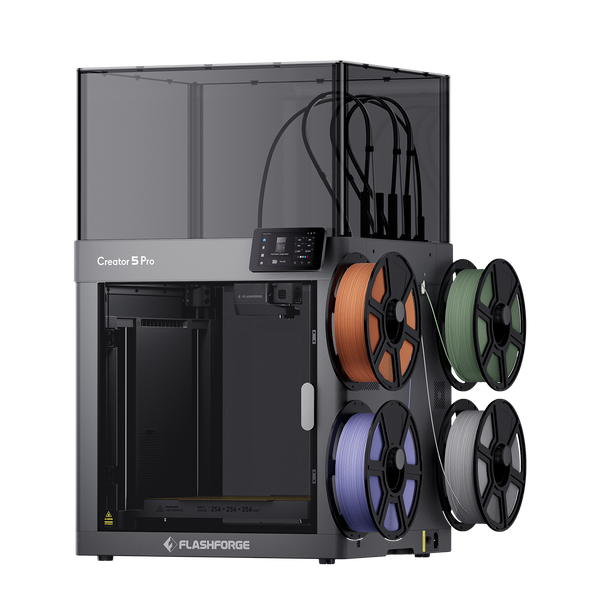
Flashforge Creator 5 Pro 4-Toolheads Enclosed Multi-Color 3D Printer | 500% Faster, Zero Purge Waste
Low-Volume Production
FDM suits short runs when designs change, parts require customization, or mold costs are hard to justify. It also supports on-demand production instead of large inventories.
Multi-color and multi-material work can add waiting time and purge waste when several filaments share one nozzle. The Flashforge Creator 5 uses four independent toolheads, with each material assigned to its own toolhead. This arrangement supports automatic tool changes and helps reduce purging during repeated multi-color or multi-material production.
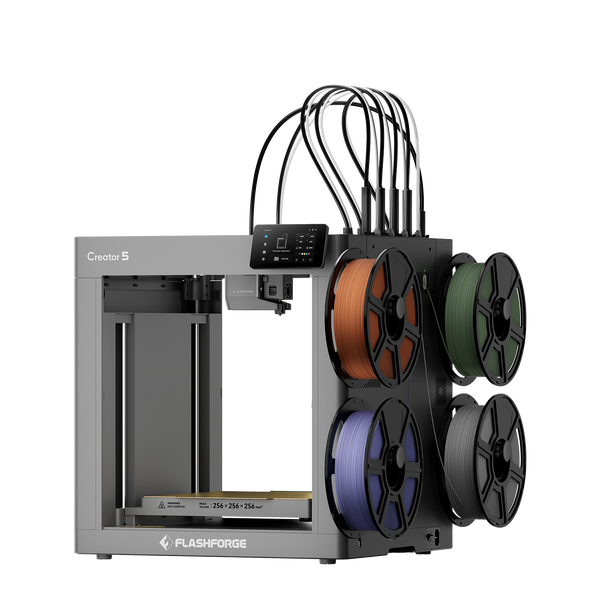
Flashforge Creator 5 4-Toolheads Multi-Color 3D Printer | 500% Faster, Zero Purge Waste
Education and Hobby Projects
FDM connects digital design with a physical result, making it useful for classroom models, engineering exercises, tabletop pieces, and household projects. Beginners still need instruction on hot surfaces, moving components, and ventilation.
For projects in which color is part of the design, the Flashforge AD5X supports four-color printing, one-click auto leveling, and automatic filament loading and switching. These features make it suitable for educational models, character prints, and everyday multi-color creative work.
Common Factors That Affect 3D Printing Method Selection
FDM should be selected by comparing the finished part’s requirements—not simply by choosing the most familiar process.
Material Requirements
Consider load, impact, flexing, abrasion, heat, moisture, UV, and chemical contact. Then verify that the material and machine can provide the required nozzle, bed, enclosure, chamber, and drying conditions.
Print Quality and Part Performance
Define what “quality” means. A visual model may prioritize finish, while a fixture needs dimensional stability and strength. Test mechanical parts under realistic loads instead of relying only on bulk material values.
Cost and Production Volume
Machine time, labor, failures, supports, finishing, and downtime all contribute to cost per part. FDM is competitive for prototypes and customized short runs; dedicated tooling may become more economical at high volume.
Post-Processing Needs
Support removal, sanding, drilling, painting, bonding, sealing, and heat treatment can change both lead time and performance. Orienting the model carefully and separating it into sensible components may reduce support and finishing work before printing begins.
Conclusion
Fused deposition modeling turns digital models into thermoplastic parts through controlled material extrusion. Its accessible workflow, broad material range, and ability to produce customized geometry make it a strong choice for prototypes, tools, educational models, hobby projects, and selected short-run production.
Its limits are equally important. Layer lines, directional strength, supports, shrinkage, and material-specific printing requirements must be considered during design and setup. The best results come from treating the printer, filament, model orientation, slicer settings, and operating environment as one complete manufacturing system.
FAQ
How Accurate Is FDM 3D Printing?
There is no universal accuracy figure for every FDM printer or model. Results depend on machine calibration, nozzle size, layer height, motion control, material shrinkage, part geometry, and orientation. Check the manufacturer’s stated tolerances where available and print a representative test part before committing to a tolerance-critical project.
Why Do FDM Prints Have Visible Layer Lines?
Each layer is formed from deposited roads of plastic, so the boundaries create a stepped surface, especially on slopes and curves. Smaller layer heights can reduce the effect but usually increase print time. Model orientation and post-processing also influence the final appearance.
Does FDM Printing Require Supports?
Not always. Vertical walls and moderate overhangs may print without support, while steep overhangs, long bridges, and isolated features may need it. Good orientation, chamfers, split-part design, and tuned bridging settings can reduce unnecessary support.
How Strong Are FDM Printed Parts?
They can be strong enough for many functional applications, but strength depends on the polymer, wall thickness, infill, geometry, temperature, layer bonding, and load direction. Because layer interfaces can be weaker, orient the part around its expected loads and validate critical components with testing.
Can FDM Printed Parts Be Waterproof?
FDM parts can be made water-resistant, but a normal print should not automatically be treated as waterproof. Small gaps between extrusion lines, seams, and defects may leak. Additional walls, well-tuned extrusion, suitable materials, and compatible sealants can improve performance. Pressure-containing, potable-water, or food-contact uses require application-specific material review and testing.
Is FDM 3D Printing Safe for Indoor Use?
FDM can be used indoors when the printer is operated according to its instructions and appropriate controls are in place. Heated thermoplastics can release ultrafine particles and volatile compounds, with emissions varying by material and operating conditions. NIOSH guidance identifies ventilation as an important engineering control. Use a well-ventilated location, consider enclosure and suitable filtration, keep people away from hot and moving parts, and apply extra care in classrooms or frequently occupied rooms.